Industry News
Curation by industry experts
Hot Articles
Popular Tags
Prefabricated Construction HVAC Mistakes to Avoid
In prefabricated construction, HVAC mistakes are rarely minor. A duct routing decision made too early, a coordination assumption left unverified, or an insulation detail treated as “site-adjustable” can cascade into rework, energy loss, commissioning delays, compliance gaps, and operational complaints after modules are delivered. For modular project managers, technical evaluators, procurement teams, and facility decision-makers, the central reality is simple: the cost of an HVAC error rises sharply once fabrication is complete.
The most important takeaway is not just to “design carefully,” but to control a few high-impact risk points before manufacturing starts: module interface coordination, transport-aware equipment selection, airtightness and thermal bridging control, service access, controls integration, and commissioning strategy. Teams that address these early are far more likely to achieve reliable thermal performance, support ASHRAE-aligned design intent, and avoid expensive field fixes.
What are the most costly HVAC mistakes in prefabricated construction?
The biggest HVAC failures in prefabricated construction usually happen at the interface between factory design and site reality. In conventional construction, some conflicts can be resolved during installation. In modular and prefabricated systems, many of those same conflicts become embedded into the product before it reaches the jobsite.
The most costly mistakes typically include:
- Freezing the HVAC design before structural, architectural, and MEP coordination is complete
- Ignoring module-to-module connection tolerances for ductwork, piping, drains, and controls
- Selecting equipment based on nominal capacity only, not transport, vibration, maintenance, and lifecycle constraints
- Underestimating air leakage, insulation discontinuities, and thermal bridges at module joints
- Designing systems that are hard to commission after modules are stacked and enclosed
- Failing to define who owns factory testing, site testing, balancing, and final performance verification
These are not only engineering issues. They are commercial and operational risks. A poor HVAC decision in a prefabricated healthcare ward, cold-chain support facility, commercial plant room, or modular office block can affect schedule, occupant comfort, indoor air quality, energy-efficient HVAC performance, warranty claims, and long-term asset value.
Why do HVAC errors happen more often in modular and prefabricated projects?
Prefabricated construction compresses timelines and shifts much of the build risk upstream. That can improve quality and speed, but only when design decisions are mature enough for manufacturing. HVAC systems are particularly vulnerable because they depend on coordination across multiple disciplines and because thermal management performance is sensitive to installation quality.
Common root causes include:
- Premature design freeze: fabrication begins while coordination details are still unresolved.
- Overconfidence in BIM coordination: a clash-free model does not automatically mean maintainable, sealable, or installable systems.
- Factory-site disconnect: the fabrication team optimizes module production, while the site team inherits difficult final connections.
- Late procurement substitutions: equivalent equipment may not be equivalent in dimensions, service clearances, control logic, or acoustic performance.
- Insufficient commissioning planning: testing strategy is treated as an end-stage task rather than a design input.
For technical assessment teams and enterprise decision-makers, this means HVAC risk in modular projects should be evaluated less as a pure product issue and more as a systems-integration issue.
How does poor module interface design create HVAC failures?
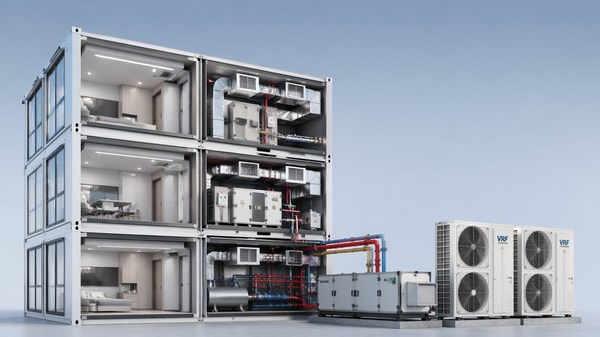
One of the most frequent and expensive prefabricated construction HVAC mistakes is poor interface definition between modules, risers, plant skids, and site-installed systems. In many projects, the HVAC design inside each module looks complete, but the transition points between modules are underdeveloped.
That creates problems such as:
- Misaligned duct and pipe penetrations
- Drainage slopes that cannot be maintained after stacking
- Control cabling routes that interfere with firestopping or access panels
- Unsealed connections that increase air leakage and condensation risk
- Module joints that interrupt vapor barriers or insulation continuity
The practical solution is to treat every module interface as a performance-critical detail, not an assembly convenience. That means documenting:
- Exact connection locations and tolerances
- Flexible versus rigid connection rules
- Access requirements for final tie-in and maintenance
- Sealing, insulation, and fire protection responsibilities
- Testing steps before shipment and after installation
For project managers, this is one of the best checkpoints for avoiding downstream claims. If interface ownership is vague, HVAC performance risk is already high.
What equipment selection mistakes should teams avoid?
In prefabricated and modular construction, HVAC equipment cannot be selected on capacity and efficiency ratings alone. Teams often choose units that perform well on paper but create major manufacturing, transport, or serviceability problems in practice.
Typical mistakes include selecting equipment that:
- Exceeds transport weight or dimensional constraints
- Requires maintenance clearances unavailable after module installation
- Has vibration behavior unsuitable for lightweight modular structures
- Depends on field modifications that are difficult once enclosed in a module
- Cannot maintain expected performance under real project load diversity and zoning conditions
A better equipment selection process should evaluate at least five dimensions:
- Thermal performance: sensible/latent behavior, load response, part-load efficiency
- Physical integration: size, mounting, connection orientation, center of gravity
- Transport resilience: shipping vibration, shock protection, packaging, factory handling
- Serviceability: filter replacement, fan access, coil cleaning, valve and actuator reach
- Controls compatibility: BMS integration, sensor strategy, sequencing logic, fault diagnostics
This matters especially for commercial and industrial environments where uptime, maintainability, and lifecycle cost often matter more than lowest first cost.
Why are insulation, airtightness, and thermal bridges often underestimated?
Many teams focus on airflow and capacity while underestimating the thermal weakness introduced by module edges, service penetrations, and assembly joints. Yet in prefabricated construction, building insulation quality and air sealing are directly tied to HVAC performance. If the envelope loses integrity at repeated connection points, the HVAC system has to compensate continuously.
That leads to:
- Higher energy use
- Poor room-to-room temperature stability
- Surface condensation risk
- Mold and hygiene concerns in sensitive environments
- Occupant discomfort near joints and perimeter zones
For quality control and safety teams, the critical issue is continuity. The thermal and air barrier strategy should remain intact across:
- Module joints
- Façade interfaces
- Roof transitions
- Duct and pipe penetrations
- Access panels and maintenance openings
Where high-performance thermal management is required, details should be validated not only by drawings but by mockups, sealant specifications, assembly procedures, and inspection criteria. This is where prefabricated construction, industrial HVAC, and building chemicals/insulation decisions become tightly linked.
How do controls and commissioning failures undermine system performance?
A common misconception is that factory-built HVAC systems are easier to commission. In reality, they are easier to preassemble, but not automatically easier to verify. Many modular projects suffer because controls philosophy, sensor placement, test points, and handover responsibilities are not finalized before fabrication.
Typical controls and commissioning mistakes include:
- Sensor locations that are convenient for assembly but poor for control accuracy
- Inconsistent point naming and BMS integration logic across modules
- No clear plan for factory acceptance testing versus site acceptance testing
- Inadequate balancing access after modules are installed
- Sequences of operation that do not reflect real occupancy or load diversity
To avoid this, teams should define a staged commissioning strategy:
- Design-stage review: confirm performance intent, zoning, access, and sensor logic
- Factory verification: inspect assembly quality, controls wiring, labeling, and basic functional tests
- Site integration testing: validate final connections, communication networks, leak integrity, and startup sequences
- Operational tuning: verify comfort, pressure relationships, alarms, and part-load energy behavior under real use
For ASHRAE-aligned projects, documenting measurable performance criteria early is far more effective than trying to “commission quality into the system” after installation.
What should decision-makers check before approving a prefabricated HVAC solution?
Enterprise buyers, procurement directors, and project leaders do not need to review every engineering detail personally, but they do need a clear framework to judge whether a prefabricated HVAC approach is credible, scalable, and low risk.
Before approval, ask these questions:
- Has the design been coordinated to module interfaces, not just within modules?
- Are thermal loads and ventilation requirements based on actual use cases?
- Have insulation continuity, airtightness, and condensation risks been addressed at joints?
- Is there a documented factory-to-site testing and commissioning plan?
- Can all critical components be serviced after the building is assembled?
- Are equipment substitutions controlled through a formal technical review process?
- Are performance targets tied to recognized standards and measurable acceptance criteria?
These questions help distinguish between a modular HVAC package that is merely manufacturable and one that is operationally robust.
Best practices to prevent prefabricated construction HVAC mistakes
The most effective prevention strategy is to move key HVAC decisions earlier and validate them more rigorously before fabrication starts. The following practices consistently reduce risk:
- Run multidisciplinary design reviews before design freeze
- Create interface-specific details for every duct, pipe, drain, and controls connection
- Use mockups or prototype modules for high-risk junctions
- Verify maintenance access in real geometry, not only in plan views
- Set clear acceptance criteria for airtightness, insulation continuity, and leakage
- Define factory and site commissioning responsibilities in contract documents
- Require documented compliance alignment with applicable ASHRAE, ISO, or EN references where relevant
For distributors, integrators, and technical sales teams, these same principles are also valuable commercially. Buyers are increasingly looking for suppliers who can demonstrate risk reduction, not just equipment delivery.
Conclusion: avoid upstream HVAC mistakes to protect downstream project value
In prefabricated construction, HVAC success depends less on isolated equipment quality and more on integration discipline. The mistakes that cause the most damage are usually made upstream: poor interface definition, incomplete coordination, inaccessible equipment, weak insulation continuity, and vague commissioning ownership.
For organizations responsible for critical infrastructure, modular construction programs, and energy-efficient HVAC outcomes, the right approach is clear. Evaluate prefabricated HVAC systems as fully integrated operational assets. Prioritize constructability, thermal integrity, serviceability, and verifiable performance before manufacturing begins. When those fundamentals are in place, prefabrication can deliver not only speed, but also reliable thermal management, lower lifecycle risk, and stronger long-term building performance.
Recommended News
 Industrial HVACHow to Choose Industrial HVAC for Critical InfrastructureCritical Infrastructure industrial HVAC selection guide: compare Modular Construction, Building Insulation, ASHRAE Standards, Energy-Efficient HVAC, Thermal Management, and Industrial Refrigeration for resilient, scalable projects.Dr. Julian VoltApr 29, 2026
 Industrial HVACModular Construction HVAC: What Works Best?Modular Construction HVAC: compare Energy-Efficient HVAC options for Critical Infrastructure, Building Insulation, ASHRAE Standards, and smarter Thermal Management.Dr. Julian VoltApr 29, 2026
 Industrial HVACDoes Better Building Insulation Cut HVAC Costs?Building Insulation and Energy-Efficient HVAC can cut industrial HVAC costs. Learn ASHRAE Standards-based strategies for Modular Construction, thermal management, and resilient critical infrastructure.Dr. Julian VoltApr 29, 2026
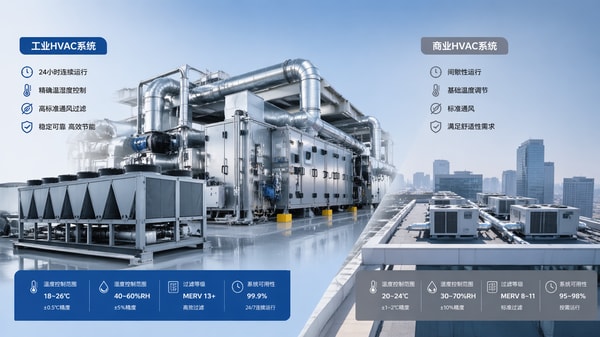
 Industrial HVACIndustrial HVAC vs Commercial HVAC: Key DifferencesIndustrial HVAC vs Commercial HVAC: explore key differences in Thermal Management, ASHRAE Standards, Energy-Efficient HVAC, and Critical Infrastructure planning for smarter facility decisions.Dr. Julian VoltApr 29, 2026