Industry News
Curation by industry experts
Hot Articles
Popular Tags
Industrial HVAC vs Commercial HVAC: Key Differences
Industrial HVAC and Commercial HVAC may appear similar, but their design logic, Thermal Management demands, compliance scope, and operational risks are fundamentally different. For stakeholders evaluating Critical Infrastructure, Energy-Efficient HVAC performance, ASHRAE Standards, and integration with Industrial Refrigeration, Building Insulation, or even Modular Construction and Prefabricated Construction environments, understanding these distinctions is essential for safer operations, lower lifecycle cost, and smarter capital planning.
For researchers, operators, technical evaluators, procurement teams, project managers, and enterprise decision-makers, the distinction is more than terminology. It affects equipment sizing, redundancy strategy, maintenance intervals, air quality control, temperature stability, and the financial model behind a facility’s 10- to 20-year operating life.
In practical terms, choosing the wrong HVAC approach can lead to unstable production conditions, compliance failures, excessive energy use, or avoidable downtime. In sectors tied to pharmaceuticals, food processing, warehousing, electronics, logistics, and complex urban infrastructure, that mismatch can become a direct operational and commercial risk.
Industrial HVAC vs Commercial HVAC: Core Definitions and Design Intent
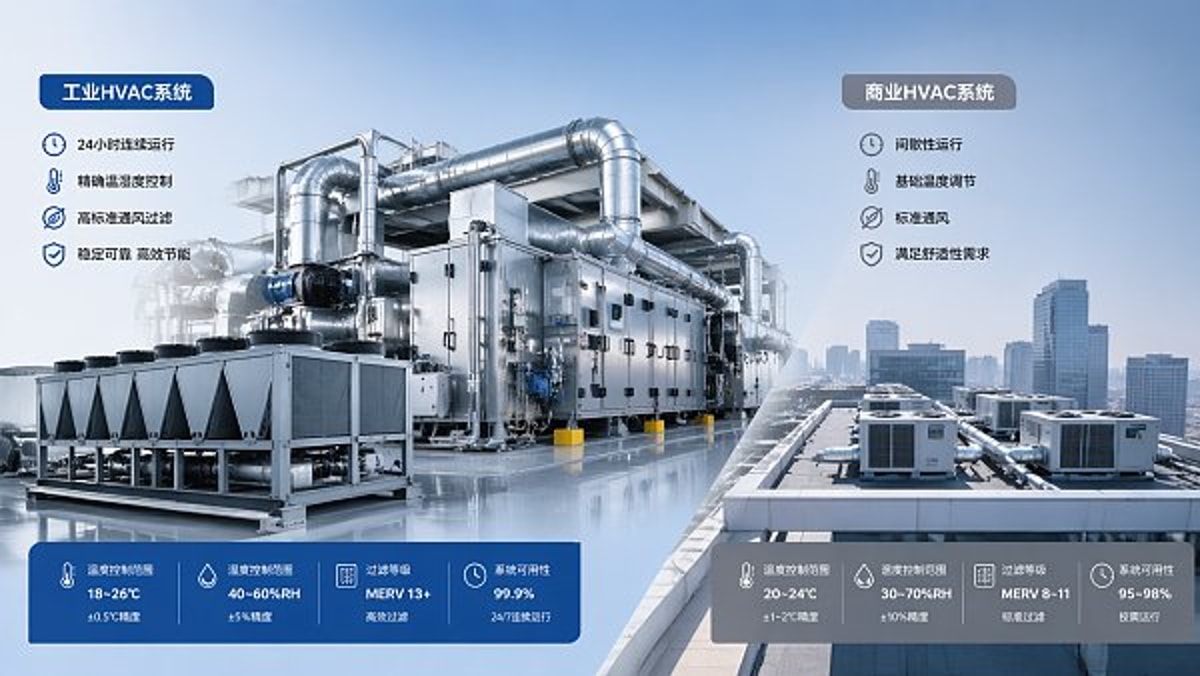
Commercial HVAC is primarily designed to support human comfort in offices, malls, hotels, schools, hospitals, and mixed-use buildings. Its baseline objective is to maintain occupant-friendly indoor conditions, often within a temperature band of around 20°C to 24°C and relative humidity ranges suited to daily occupancy patterns, comfort expectations, and building code requirements.
Industrial HVAC, by contrast, is engineered around process reliability, equipment protection, product quality, worker safety, and environmental control under far more variable or extreme loads. In many industrial settings, temperature targets may need to hold within ±1°C to ±2°C, and humidity tolerances may be far tighter than those in standard office or retail buildings.
The difference becomes clearer when looking at load behavior. Commercial HVAC often follows predictable occupancy cycles across 8 to 16 hours per day. Industrial HVAC may operate 24/7, manage internal heat from machinery, remove corrosive fumes, handle dust or solvent vapors, and support pressure-controlled clean zones or production-critical spaces.
This also changes the engineering philosophy. A commercial system may prioritize low noise, tenant flexibility, and zone comfort. An industrial system often prioritizes air changes per hour, filtration level, make-up air balance, heat rejection, process isolation, and equipment resilience under continuous duty.
Where the Two Systems Overlap—and Where They Do Not
Both systems include familiar elements such as chillers, air handling units, ductwork, controls, and ventilation networks. However, overlap in components does not mean overlap in performance criteria. A rooftop unit suitable for a retail complex may be entirely inappropriate in a chemical process area, battery manufacturing line, or cold-chain transfer hub.
Industrial projects also more frequently require integration with process exhaust, industrial refrigeration, explosion-risk zoning, cold storage, building envelope insulation, and modular plant-room layouts. In these cases, HVAC becomes part of the production infrastructure rather than a standalone building utility.
The table below summarizes the most important technical differences in a decision-friendly format.
The key takeaway is simple: commercial HVAC is usually building-centric, while industrial HVAC is process-centric. That one distinction shapes nearly every downstream decision, from airflow rates to filtration grade, redundancy design, and lifecycle budgeting.
Performance Requirements, Environmental Control, and Compliance Scope
One of the largest differences between industrial HVAC and commercial HVAC is the performance threshold they must maintain under real operating conditions. In a standard commercial building, moderate temperature drift may reduce comfort but rarely stops the business. In industrial production, even a 2°C to 3°C deviation can disrupt quality control, calibration, storage integrity, or process repeatability.
Humidity is another dividing line. Commercial spaces may target broad comfort ranges such as 40% to 60% RH. Industrial environments may demand much narrower bands, especially in pharmaceuticals, electronics, packaging, food processing, clean manufacturing, and cold-chain support areas. In such cases, HVAC is tied directly to product yield and reject rates.
Ventilation and contamination control requirements also differ sharply. Commercial systems may prioritize fresh air rates and odor control. Industrial systems often need fume extraction, particulate capture, pressure cascades, filtration staging, and air changes that are many times higher than normal comfort spaces. Some applications require multiple risk zones with isolated return air or dedicated exhaust paths.
Compliance reflects this complexity. Commercial HVAC usually focuses on building codes, energy rules, and occupant health requirements. Industrial HVAC may additionally need to align with process hygiene protocols, hazardous material handling rules, internal quality systems, and stricter interpretations of ASHRAE, ISO, and EN guidance depending on facility type and region.
Typical Control Variables in Industrial Facilities
- Temperature stability, often maintained within ±1°C to ±2°C for process consistency.
- Relative humidity control, sometimes limited to a 5% to 10% operating band.
- Pressure differentials between adjacent rooms to prevent cross-contamination or uncontrolled infiltration.
- Filtration levels tailored to particle sensitivity, hygiene requirements, or equipment protection.
- Ventilation rates linked to heat load, fumes, dust generation, or solvent management.
Why Standards Matter in Procurement and Engineering Review
For technical and business evaluators, standards are not a paperwork issue; they are a risk-control framework. ASHRAE guidance helps define load calculations, thermal comfort, ventilation, and energy performance. ISO and EN references may shape filtration, testing, construction tolerances, and process environment control. A facility serving food, healthcare, or cold-chain logistics may face even tighter documentation and validation expectations.
This means that equipment selection should never be separated from compliance mapping. If a system is chosen only on first cost, but later requires redesign of duct materials, controls, insulation interfaces, or filtration stages, the total project cost can increase by 15% to 30% through change orders, delay, and lost commissioning time.
Equipment Architecture, Integration Demands, and Lifecycle Cost
Commercial HVAC often uses packaged rooftop units, variable refrigerant flow systems, split systems, or centralized chilled water solutions sized around occupancy and envelope loads. Industrial HVAC may use heavy-duty air handling units, process exhaust systems, chilled water plants, dehumidification modules, heat recovery loops, and high-capacity ventilation systems designed around production loads that fluctuate by shift, season, or process stage.
Industrial facilities also demand stronger integration with adjacent infrastructure. This may include industrial refrigeration, cold storage docks, insulated panels, smoke control, process water, building management systems, and modular mechanical rooms. In prefabricated construction or modular construction environments, HVAC coordination must often happen earlier, because duct routing, structural openings, and service clearances are locked sooner than in conventional builds.
Lifecycle economics differ as well. A lower-cost commercial-grade system may appear attractive during bidding, but if it cannot withstand 24-hour duty cycles, washdown conditions, airborne contaminants, or repeated thermal swings, maintenance frequency rises quickly. In industrial settings, maintenance every 3 months instead of every 6 to 12 months can change the full operating budget substantially.
Downtime cost is often the decisive factor. In a commercial office, one unit outage may inconvenience occupants. In an industrial plant, one failed air handling train can halt a line, compromise product quality, or trigger sanitation and restart procedures that take 6 to 24 hours. That is why redundancy, maintainability, and spare-parts strategy matter more in industrial HVAC.
Typical Design Priorities by Application Type
The right configuration depends on the facility mission. The comparison below helps project owners and distributors align system architecture with real operational needs rather than generic equipment categories.
The table shows why equipment cannot be selected in isolation. HVAC performance depends on envelope design, internal heat sources, workflow patterns, and the interfaces between thermal systems and spatial infrastructure. That is particularly relevant for large campuses, multi-temperature sites, and facilities with modular expansion plans.
Common Cost Blind Spots
- Undersized ventilation for production heat loads, causing unstable room conditions after commissioning.
- Weak coordination between HVAC and building insulation, leading to condensation, infiltration, and extra energy loss.
- No redundancy plan for critical zones, increasing outage risk in 24/7 facilities.
- Maintenance access ignored during design, which increases service time and shutdown duration.
How to Choose the Right System for Your Facility
The best choice is not “industrial” or “commercial” in name alone. It is the system whose design basis matches the facility’s risk profile, operating schedule, environmental tolerances, and growth plan. A warehouse office can use commercial HVAC, while the adjacent temperature-controlled loading zone may require industrial-grade ventilation and moisture management.
Selection should begin with a structured review of five variables: load intensity, environmental tolerance, compliance burden, operational continuity, and integration complexity. If three or more of these variables are high, the project usually moves closer to industrial HVAC logic, even if the building itself looks similar to a commercial property.
For procurement leaders, comparing capital cost alone is not enough. The more useful metric is lifecycle value over 10 to 15 years, including energy, planned maintenance, spare parts, downtime exposure, and retrofit probability. This framework gives a much clearer picture for manufacturing, cold-chain, and infrastructure operators.
For project managers, early stakeholder alignment is essential. HVAC design should be reviewed jointly by operations, quality assurance, EHS, engineering, and finance before final specification. That process usually prevents late-stage redesign and improves handover quality.
Practical Selection Checklist
- Define whether environmental control is for people, products, machinery, or all three.
- Map required operating hours: standard daytime use, 2 shifts, or 24/7 duty.
- List tolerances for temperature, humidity, airborne particles, and pressure control.
- Assess whether the system must integrate with refrigeration, insulated construction, or modular plant infrastructure.
- Estimate the acceptable downtime window: minutes, hours, or a planned shutdown cycle.
The following decision table can support early-stage technical and commercial screening.
If a project ranks high on control precision, continuity, and compliance, industrial HVAC is usually the safer path. If comfort and standard occupancy are the dominant needs, commercial HVAC remains the more practical and cost-efficient option.
Implementation Risks, Common Mistakes, and Operational Best Practices
Many HVAC problems do not begin during operation; they begin during assumption-making. A common mistake is classifying a facility by building type instead of process demand. For example, a logistics center may look like a commercial warehouse, but if it contains cold-chain staging, battery charging zones, or product-sensitive storage, the HVAC strategy must be upgraded accordingly.
Another frequent error is treating insulation, airflow, and refrigeration as separate scopes. In reality, thermal performance depends on all three. Poorly detailed building insulation or panel joints can increase heat gain, create surface condensation, and force HVAC and refrigeration equipment to run longer cycles, sometimes adding 8% to 20% to energy demand depending on climate and usage intensity.
Commissioning quality is equally critical. A system may have the right installed capacity but still underperform if balancing, sensor placement, control tuning, and alarm logic are not validated. In industrial settings, commissioning should include load testing, failure mode checks, sequence verification, and operator training, typically across 3 stages: pre-functional inspection, functional testing, and performance verification.
Maintenance strategy should be matched to risk. Commercial buildings may rely on standard preventive schedules. Industrial sites usually benefit from a mix of preventive and condition-based maintenance, especially for filters, fans, bearings, valves, sensors, and control components in critical zones. Review frequency may range from monthly checks in harsh environments to quarterly checks in more stable conditions.
Best Practices for Long-Term Performance
- Validate the design basis against real production loads, not only nameplate assumptions.
- Coordinate HVAC with industrial refrigeration, insulation, and spatial layout early in design.
- Use zoning and controls that reflect operating schedules, risk zones, and maintenance access.
- Plan spare-parts coverage for the first 12 to 24 months of operation in critical facilities.
- Train operators on alarm response, setpoint discipline, and cleaning procedures to reduce hidden performance drift.
FAQ: Questions Often Raised by Buyers and Technical Teams
How do I know if my facility needs industrial HVAC rather than commercial HVAC?
If your operation depends on tight environmental control, runs more than 16 hours per day, includes process heat or contaminants, or faces product-quality risk from HVAC failure, industrial HVAC is usually the correct framework.
Can one site use both commercial and industrial HVAC?
Yes. Mixed-use sites commonly do this. Offices, meeting rooms, and administrative zones may use commercial HVAC, while production halls, cold rooms, clean areas, and technical spaces use industrial HVAC strategies with separate controls and maintenance plans.
What is the most overlooked factor during procurement?
Integration. Many buyers compare equipment but overlook the impact of envelope insulation, process exhaust, controls, and maintenance access. These factors often determine whether the promised efficiency and stability are achieved after handover.
How long does implementation usually take?
For standard commercial installations, implementation may take several weeks depending on scale. For industrial projects, engineering, coordination, and commissioning can extend into multi-phase schedules because the system must be integrated with process utilities, safety requirements, and validation procedures.
Industrial HVAC and Commercial HVAC serve different missions, and that difference affects design, compliance, maintenance, risk exposure, and total cost of ownership. Commercial HVAC supports people and building comfort. Industrial HVAC protects processes, products, equipment, and operational continuity in more demanding environments.
For organizations planning new facilities, retrofits, cold-chain expansions, or modular infrastructure projects, the right HVAC decision should be based on real operating conditions rather than simplified building labels. A disciplined evaluation of environmental tolerances, downtime risk, and integration needs leads to stronger performance and more predictable lifecycle value.
If you are assessing thermal infrastructure, comparing system architectures, or preparing a procurement roadmap, now is the right time to get a tailored technical review. Contact us to discuss your project, request a customized solution, or explore more HVAC, cold-chain, insulation, and modular infrastructure options aligned with your operational goals.
Recommended News
 Industrial HVACHow to Choose Industrial HVAC for Critical InfrastructureCritical Infrastructure industrial HVAC selection guide: compare Modular Construction, Building Insulation, ASHRAE Standards, Energy-Efficient HVAC, Thermal Management, and Industrial Refrigeration for resilient, scalable projects.Dr. Julian VoltApr 29, 2026
 Industrial HVACModular Construction HVAC: What Works Best?Modular Construction HVAC: compare Energy-Efficient HVAC options for Critical Infrastructure, Building Insulation, ASHRAE Standards, and smarter Thermal Management.Dr. Julian VoltApr 29, 2026
 Industrial HVACDoes Better Building Insulation Cut HVAC Costs?Building Insulation and Energy-Efficient HVAC can cut industrial HVAC costs. Learn ASHRAE Standards-based strategies for Modular Construction, thermal management, and resilient critical infrastructure.Dr. Julian VoltApr 29, 2026
 Industrial HVACIndustrial HVAC vs Commercial HVAC: Key DifferencesIndustrial HVAC vs Commercial HVAC: explore key differences in Thermal Management, ASHRAE Standards, Energy-Efficient HVAC, and Critical Infrastructure planning for smarter facility decisions.Dr. Julian VoltApr 29, 2026