Industry News
Curation by industry experts
Hot Articles
Popular Tags
When is cryogenic milling suitable for pharmaceutical ingredients?
Cryogenic milling is suitable for pharmaceutical ingredients when cooling solves a demonstrated grinding problem: softening, smearing, excessive heat exposure, or poor fracture of a tough material. Its strongest justification is a measurable improvement in usable powder yield, ingredient stability, or downstream performance compared with conventional milling. A smaller particle size alone is insufficient if the process also introduces moisture, changes the solid form, or produces powder that cannot be transferred and formulated consistently.
A useful starting point is to establish whether temperature actually limits the existing process. Material coating the grinding surfaces suggests softening, while rising impurity levels suggest chemical instability. Broad particle-size distribution could instead result from inconsistent feeding, unsuitable mill geometry, or inadequate classification. These observations require different responses; introducing liquid nitrogen before identifying the cause can add complexity without correcting the failure.
Materials that gain a practical advantage from cooling
Waxy, fatty, and some polymeric ingredients are strong candidates when they deform under impact at the normal milling temperature. Cooling can move suitable materials into a more brittle state, allowing fracture instead of stretching or smearing. The relevant threshold comes from the ingredient’s mechanical behavior and formulation composition. Liquid nitrogen’s boiling temperature does not define the required product temperature, and the coldest achievable condition is rarely the most useful operating target.
For amorphous polymers, a glass transition can help explain temperature-dependent brittleness. For crystalline or mixed materials, melting behavior, phase composition, and mechanical testing provide additional guidance. Moisture and plasticizers can shift the response substantially. A milling temperature established with a dry laboratory sample therefore needs confirmation using feed that represents routine production conditions.
Heat-sensitive active pharmaceutical ingredients warrant evaluation when conventional grinding creates a verified temperature-related loss of quality. Examples include increased degradation products, discoloration linked to chemical change, or loss of functional activity. Cooling reduces thermal exposure, but it does not remove impact, shear, or newly generated surface area. Proteins and other biologically active materials require particular caution because reduced temperature does not establish protection against mechanical damage.
Some fibrous botanical ingredients also fracture more readily after cooling. Their suitability depends on the intended specification: easier grinding has limited value if variable moisture, volatile constituents, or heterogeneous composition still prevent consistent powder quality.
Define the powder requirement before choosing the cooling intensity
The target should reflect the next processing step. A dissolution-driven application may require increased surface area, while a blend may need a particle-size distribution that limits segregation. Excessive fines can increase cohesion, dust generation, electrostatic effects, and losses during transfer. A process that produces a smaller median size can still perform poorly if it creates a large fine fraction or leaves an unacceptable coarse tail.
Record the distribution using an appropriate method, including the lower, middle, and upper portions rather than relying on one average. Particle shape also matters: fractured flakes and elongated particles behave differently from compact particles of similar measured size. Microscopy helps explain discrepancies between size results, flow behavior, and apparent agglomeration.
Measurements need a defined dispersion procedure. Strong dispersion can break weak agglomerates and report primary particle size, while gentle handling better represents powder entering a hopper or blender. Both measurements can be useful, provided their purposes are clear. Changing the dispersion method between trial conditions can create an apparent milling improvement that originates in sample preparation.
Separate thermal protection from solid-state preservation
A low outlet temperature does not prove that an ingredient retains its original solid form. Milling introduces mechanical energy that can create crystal defects or amorphous content even under cold conditions. These changes can influence dissolution, moisture uptake, storage stability, and processing behavior. Their acceptability depends on the intended ingredient and formulation specifications.
Compare the feed and milled product using solid-state methods selected for the material. X-ray powder diffraction and differential scanning calorimetry often provide complementary information; additional methods are warranted when hydrates, solvates, or subtle phase changes are relevant. Chemical assay alone cannot establish preservation of crystal form.
Sample timing is equally important. A powder examined immediately after milling may differ from the same powder after warming, moisture exposure, or storage. Evaluate the condition that will enter manufacturing, including the planned hold period and packaging. Where the ingredient is temperature-sensitive, record the warming stage as part of its thermal history.
Cryogenic milling also increases exposed surface area. That can accelerate subsequent reactions even when degradation during grinding is reduced. A successful cold milling trial therefore needs stability evidence appropriate to the expected storage and processing interval, rather than relying only on an immediate post-milling assay.
Moisture control continues through warming and transfer
Cold powder exposed to humid air can collect condensed moisture or frost. For hygroscopic ingredients, this can cause agglomeration, altered flow, or changes in solid form. Ice can also make an initially free-flowing sample appear satisfactory before melting reveals a handling problem. The process boundary must include collection, warming, sampling, and transfer.
A dry, enclosed collection system with a controlled gas environment reduces exposure. The surrounding gas dew point must remain below the temperature of exposed product surfaces wherever condensation is to be avoided. Keeping powder sealed while it warms is useful only if the container and its internal atmosphere are sufficiently dry; sealing humid gas inside does not solve the problem.
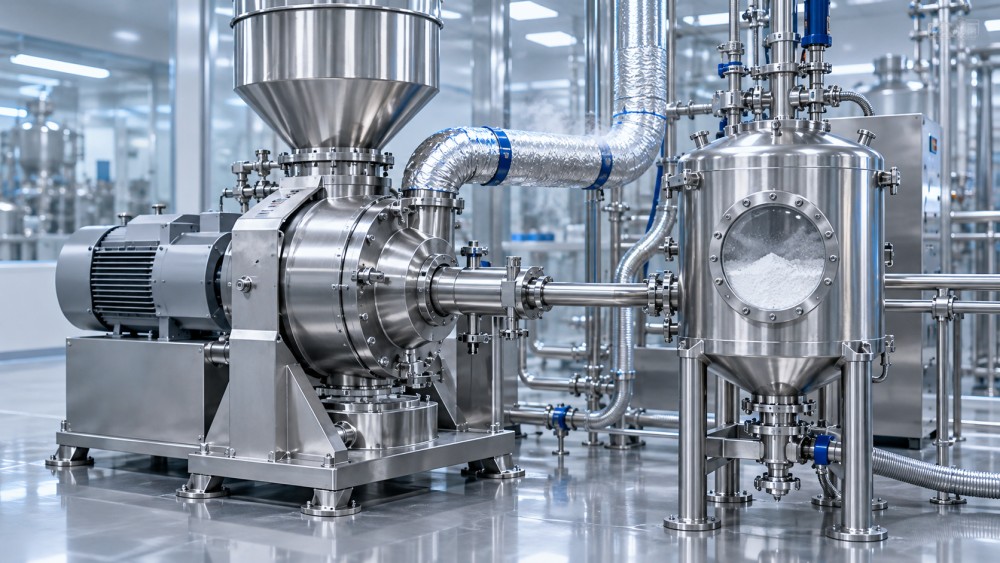
The temperature of the powder leaving the mill, the coldest collection surfaces, and the collection atmosphere should be assessed together. A room humidity reading alone cannot describe the condensation risk inside a cold receiver. Moisture testing after the actual warming and transfer sequence is more informative than testing a sample removed under unusually favorable laboratory conditions.
Where oxidation is a concern, nitrogen can reduce oxygen exposure within a controlled enclosure. Residual oxygen, leaks, and later handling still determine the protection achieved. Any advantage gained in the mill must persist through the process stages in which the newly created surfaces remain reactive.
Equipment selection follows the material response
Precooling the feed and cooling the grinding zone serve different purposes. Precooling helps a ductile ingredient enter the mill in a brittle condition. Cooling during grinding removes heat generated by size reduction. A system using only precooling can lose its advantage if the material warms before discharge; an arrangement focused only on the chamber can struggle if incoming feed deforms before sufficient cooling occurs.
Mill geometry determines impact intensity, residence time, and the way particles leave the grinding zone. Screens and classifiers affect the coarse fraction, but recirculation increases exposure to mechanical energy and can increase cryogen demand. Equipment comparisons should use the required product distribution and recovered yield, not nominal throughput alone.
Temperature measurement deserves careful interpretation. A sensor in the gas stream does not necessarily represent the powder temperature, and an outlet reading can miss warmer regions within the mill. Sensor location, response time, and the relationship between measured temperature and ingredient quality need to be established during trials. Product-related measurements are especially valuable when thermal degradation drives the selection.
Contact materials, seals, and grinding components must suit the ingredient and repeated cooling cycles. Abrasive feeds can cause wear and introduce contamination despite low operating temperature. Nitrogen quality must be suitable for its contact with the process, while equipment design must support cleaning, inspection, and containment. Cryogen boil-off also requires adequate exhaust capacity and oxygen-deficiency controls appropriate to the installation.
A trial that can support a selection decision
Start with a documented conventional milling baseline. Include feed properties, operating conditions, product temperature, particle-size distribution, assay or impurities where relevant, recovered mass, and the downstream attribute that motivates milling. This gives the cooled process a meaningful reference and prevents an optimized cryogenic trial from being compared with a poorly controlled baseline.
The first cooled trials should identify a useful temperature range and the feed rate at which the desired fracture behavior remains stable. Changing feed rate, cooling intensity, and mill speed simultaneously makes the source of improvement difficult to establish. Temperature control should follow a demonstrated quality relationship instead of an arbitrary low setpoint.
Trial evaluation is most useful when it includes:
- A mass balance: account for collected product, retained material, dust, and rejected fractions. Attractive size results from a small recovered portion can conceal substantial loss.
- Samples taken during stable operation and during relevant transitions, especially startup and restart after an interruption.
- The intended downstream operation. A blending, granulation, compression, or dissolution assessment reveals whether the changed powder actually serves its purpose.
- Inspection of deposited material and wear, with analytical investigation where contamination could affect the specification.
Representative feed variability belongs in the trial program. Moisture, initial particle size, bulk density, and composition influence cooling and fracture. A single favorable lot provides limited evidence for an ingredient whose properties vary materially between batches.
Scale-up is constrained by heat balance and powder handling
At larger scale, cryogen demand reflects incoming feed temperature, grinding heat, heat entering through equipment surfaces, and losses during idle periods. Consumption measured during a short laboratory run can be distorted by the initial cooling of the equipment. Record startup consumption separately from steady production, then express routine demand against the mass of acceptable recovered product.
Gas generated by cryogen evaporation also affects powder transport, filters, receiver pressure, and collection efficiency. Increasing liquid nitrogen flow can change particle entrainment or overload a collection arrangement even when temperature control improves. The mill, receiver, filter, and exhaust system therefore need to operate as a coordinated process.
A selection is supported when representative trials establish an operating range that delivers the required powder quality, preserves the relevant chemical and solid-state attributes, and remains workable through collection and downstream processing. If cooling provides no material benefit over a controlled conventional process, the added cryogen supply and handling requirements have little technical justification. Where the benefit is clear, equipment specifications should capture that demonstrated operating range and its measurable acceptance criteria.
Recommended News
 VRF ControlVRF Control Systems for Campuses: Managing Multiple Buildings and ZonesVRF control systems for campuses simplify multi-building HVAC management. Explore integration, zoning, costs, and commissioning for a scalable system.Dr. Julian VoltNov 08, 2026
 Maglev ChillersChoosing Magnetic Levitation Chillers: Capacity and Part-Load EfficiencyChoosing Magnetic Levitation Chillers? Compare capacity, part-load efficiency and plant energy use to find the right fit for your facility.Dr. Julian VoltNov 07, 2026
 VRF ControlVRF System Quotation: What to Check Before Comparing Supplier BidsCompare every VRF system quotation with confidence. Learn how to assess capacity, installation scope, controls, warranties, and hidden costs before choosing a supplier.Dr. Julian VoltNov 06, 2026
 Maglev ChillersChoosing a Magnetic Levitation Chiller Exporter: Service and Warranty ChecksChoosing a magnetic levitation chiller exporter? Discover essential service, warranty, spare-parts, and commissioning checks to make a confident investment.Dr. Julian VoltNov 05, 2026