Industry News
Curation by industry experts
Hot Articles
Popular Tags
What Industrial HVAC Specifications Should Suppliers Provide?
Industrial HVAC suppliers should provide a project-specific specification package covering design conditions, delivered heating and cooling capacity, electrical demand, airflow or water flow, filtration, refrigerants, controls, installation requirements, and verified performance. The package should also define the scope of supply, operating limits, acceptance criteria, and service obligations. A catalog sheet establishes the equipment family; a selection report establishes whether the proposed configuration meets the facility’s requirements.
Meaningful comparison starts with a shared design basis. Two systems carrying the same nominal capacity can deliver different useful output, consume different amounts of electricity, and require different supporting infrastructure. Every proposal should identify the conditions behind its figures and distinguish guaranteed performance from estimates.
Establish the conditions behind every rating
The specification should state outdoor design temperatures, indoor temperature and humidity targets, site altitude, and the operating schedule. Air systems also need entering-air conditions and outdoor-air quantities. Hydronic equipment needs entering and leaving fluid temperatures, fluid composition, and design flow. Without these inputs, capacity and efficiency figures cannot be compared consistently.
Load assumptions deserve equal attention. Occupancy, process heat, exhaust replacement air, door openings, and equipment schedules affect the required output. A system serving a continuously operating process has a different load profile from one serving an intermittently occupied warehouse. The selection report should identify the supplied load data and any assumptions introduced during equipment selection.
Require an operating envelope alongside the design point. This should show allowable ambient temperatures, fluid temperatures, flow limits, and minimum stable output. For equipment exposed to extreme weather, the proposal should describe derating, protective shutdowns, and any accessories required to operate at the specified limits.
Compare delivered capacity and whole-system power
Cooling specifications should distinguish total capacity from sensible capacity. Total cooling includes moisture removal; sensible cooling addresses temperature reduction. A unit meeting the total load can still miss the sensible requirement if its selected coil conditions allocate too much capacity to dehumidification. Conversely, temperature control alone does not establish that the humidity target will be maintained.
Air-handling selections should identify whether quoted capacity is gross coil capacity or net capacity after relevant fan heat. For chillers, useful output should be stated at the project’s chilled-water temperatures and condenser conditions. Any adjustment for glycol, altitude, fouling allowance, or other specified conditions should appear in the selection rather than remain an undocumented correction.
Heating data should include available output and input power or fuel consumption at the required conditions. Heat-pump proposals need performance at the winter design temperature, together with defrost behavior and the contribution of auxiliary heat. A favorable mild-weather rating does not establish cold-weather heating capability.
Efficiency comparisons must use the same boundary. Compressor-only power excludes fans, pumps, and other loads that may materially affect operation. Require an explicit list of included auxiliaries and separately stated external loads. If annual energy estimates are offered, they should use the same weather assumptions, load schedule, temperature setpoints, and control strategy across competing proposals.
Part-load data should reveal both efficiency and controllability. Minimum stable capacity, compressor staging, variable-speed range, and cycling behavior determine whether the system can follow low loads. A high full-load efficiency figure provides little insight into a plant that spends much of its operating time below design output.
Airflow, water flow, and filtration must fit the installation
An air-system specification should include supply, return, outdoor, and exhaust airflow where applicable. Fan selections need external static pressure, speed, motor input, and the selected operating point on the fan curve. The proposal should identify which pressure losses are internal to the unit and which belong to external ducts and accessories.
Filter condition changes the comparison. A fan selected only against clean-filter resistance can lose airflow as filters load, or increase power when controls maintain constant airflow. The specification should state clean and final design resistance, the airflow control method, and the available pressure margin.
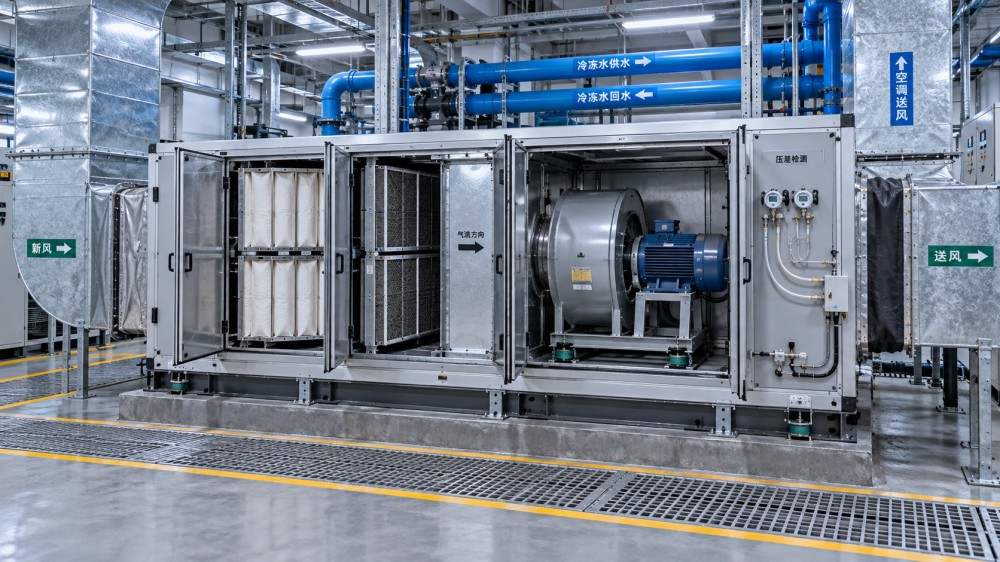
Filtration information should name the classification method, filter stages, dimensions, sealing arrangement, and replacement access. A filtration rating alone does not establish installed performance: bypass around poorly sealed frames allows untreated air to pass through. Where process contaminants require gas-phase filtration or specialized extraction, ordinary particulate filtration does not address that requirement.
For hydronic systems, provide heat-exchanger pressure drop at the selected flow and fluid temperature. Glycol concentration affects heat transfer, viscosity, and pumping demand, so water-based selections cannot simply be carried over. Include minimum and maximum flow, allowable working pressure, connection sizes, water-quality limits, and freeze-protection requirements.
These details expose installation tradeoffs. A compact heat exchanger with a higher pressure drop can increase pumping requirements, while a larger air-handling unit can reduce internal resistance but demand more plant-room space. Equipment price alone does not capture either consequence.
Refrigerants, construction, and site constraints
Refrigerant data should identify the refrigerant, charge quantity, safety classification, and circuit arrangement. The specification should explain any leak detection, ventilation, isolation, or other protective provisions required for the proposed application under applicable rules. For field-connected systems, distinguish factory charge from additional charge associated with the installed piping.
Material selections should match the exposure. Coil materials, casing construction, protective coatings, drain pans, and insulation need clear descriptions. Coastal air, corrosive process atmospheres, washdown, and outdoor exposure create different requirements. A statement such as “corrosion resistant” should be supported by the specified material or coating and its intended service environment.
Dimensional drawings should show operating weight, shipping sections, connection locations, service clearances, and component removal paths. Roof-mounted equipment also requires support and loading information. A unit that fits within a footprint may still be impossible to maintain if a coil or fan assembly cannot be withdrawn.
Acoustic data needs a defined measurement basis. Sound power and sound pressure are different quantities; sound pressure also depends on distance and surroundings. Require the operating condition, measurement method, and relevant frequency information where tonal noise or low-frequency transmission matters. Vibration isolation details should identify the assumptions about the supporting structure.
Controls integration needs a usable sequence
A communication protocol name is only the beginning of a controls specification. The package should include a point schedule showing readable values, writable commands, alarms, units, update behavior, and any required gateway or license. It should identify which functions remain under local equipment control and which accept supervisory commands.
The sequence of operation should explain startup, shutdown, staging, temperature reset, lead-lag rotation, and alarm response. For humidity-sensitive applications, it should also explain how cooling, reheating, and airflow interact. Independent control loops that repeatedly counteract one another can waste energy while producing unstable conditions.
Communication loss and power restoration require explicit behavior. State whether equipment continues with local setpoints, stops, or enters another defined mode. Include restart delays and coordination with other equipment. Where remote connectivity is included, document access controls, supported update arrangements, and the ability to operate locally when the remote service is unavailable.
Redundancy claims should identify the failure being addressed. Multiple refrigeration circuits provide a different level of continuity from independent units with separate power and controls. State the capacity available after the specified failure and identify shared components that remain potential outage points.
Match evidence to the proposed configuration
Performance evidence should reference the applicable test method and the equipment configuration it covers. Certification, where applicable, must be relevant to the proposed model and rating scope. A component certificate does not automatically substantiate the performance of an assembled system, and a general quality-management certificate does not verify heating or cooling output.
Factory tests and site tests answer different questions. Factory testing can confirm equipment operation under controlled conditions. Site commissioning establishes whether the installed system delivers the specified flow, temperatures, control response, and integration. The specification should define which tests are included, which require additional arrangements, and what documentation accompanies the results.
Acceptance criteria should be settled before delivery. Specify measurement locations, instruments, stabilization conditions, allowable tolerances, and responsibility for providing the required load. If seasonal conditions prevent full-load testing at handover, define the deferred test and the evidence required in the meantime. An acceptance requirement without a practical test method invites disagreement.
Make proposal differences visible before selection
Each proposal should include a departures schedule listing exceptions to the requested specification. Alternatives should remain clearly separated from the compliant base selection, with their effects on capacity, power, installation, and maintenance explained. This prevents an attractive price from concealing a reduced scope or a different design condition.
The scope schedule should allocate controls gateways, sensors, valves, pumps, electrical protection, supports, insulation, commissioning, and field wiring wherever relevant. Electrical data should cover supply requirements, running current, starting characteristics, and protective-device requirements. Missing interfaces often become installation changes because equipment and supporting systems were specified independently.
Service commitments should define warranty coverage, exclusions, response arrangements, spare-parts availability, and maintenance requirements. Consumable specifications and access requirements help establish recurring costs. Proprietary tools, software subscriptions, or restricted diagnostic access should be disclosed when they affect routine servicing.
A proposal is ready for comparison when its technical figures can be traced to agreed conditions and its obligations can be traced to a defined scope. Any unresolved assumption should remain visible in the specification, with its effect identified before equipment selection is finalized.
Recommended News
 VRF ControlVRF Control Systems for Campuses: Managing Multiple Buildings and ZonesVRF control systems for campuses simplify multi-building HVAC management. Explore integration, zoning, costs, and commissioning for a scalable system.Dr. Julian VoltNov 08, 2026
 Maglev ChillersChoosing Magnetic Levitation Chillers: Capacity and Part-Load EfficiencyChoosing Magnetic Levitation Chillers? Compare capacity, part-load efficiency and plant energy use to find the right fit for your facility.Dr. Julian VoltNov 07, 2026
 VRF ControlVRF System Quotation: What to Check Before Comparing Supplier BidsCompare every VRF system quotation with confidence. Learn how to assess capacity, installation scope, controls, warranties, and hidden costs before choosing a supplier.Dr. Julian VoltNov 06, 2026
 Maglev ChillersChoosing a Magnetic Levitation Chiller Exporter: Service and Warranty ChecksChoosing a magnetic levitation chiller exporter? Discover essential service, warranty, spare-parts, and commissioning checks to make a confident investment.Dr. Julian VoltNov 05, 2026