Industry News
Curation by industry experts
Hot Articles
Popular Tags
How Do You Compare Industrial HVAC Bids Across Countries?
Industrial HVAC bids from different countries become comparable only when they describe the same operating duty, scope of supply, compliance obligations, and delivery endpoint. Converting every quotation into one currency is necessary, but it does not reveal whether one supplier has priced a complete operating system while another has priced equipment at the factory gate.
The strongest comparison separates mandatory requirements from commercial preferences, then evaluates compliant proposals on installed cost, operating cost, and delivery risk. A lower price is meaningful only after differences in capacity, efficiency, accessories, installation responsibilities, and service coverage have been resolved.
Establish a common operating duty before comparing prices
A nominal capacity figure is not a sufficient technical baseline. Two chillers advertised at the same capacity can deliver different usable output at the intended ambient temperature, water temperatures, altitude, or fluid composition. For ventilation equipment, airflow without external static pressure and filtration requirements is similarly incomplete.
Issue a common design basis and require every bidder to return performance data against it. The baseline should identify:
- Required heating and cooling duties, including sensible and latent loads where relevant.
- Outdoor dry-bulb and wet-bulb conditions, site altitude, and indoor operating limits.
- Entering and leaving fluid temperatures, flow rates, and glycol concentration.
- Airflow, external static pressure, filtration, and humidity-control requirements.
- Operating hours, expected load profile, and allowable interruption.
- Electrical supply, including voltage, frequency, and available connection capacity.
- Redundancy requirements and any capacity that must remain available during maintenance.
These details determine whether an apparent equipment saving creates additional infrastructure costs. A proposal may require a larger electrical connection, higher pumping power, or supplementary cooling under peak conditions. Those consequences belong in the comparison, even when they sit outside the HVAC supplier’s quotation.
Distinguish comfort conditioning from process requirements. A system that maintains acceptable average room temperature may not satisfy a production process requiring tight temperature or humidity limits. Likewise, redundancy must be assessed at system level: spare chillers do not remove a single point of failure in shared pumps, controls, or electrical distribution.
Compare scope boundaries, not equipment descriptions
International bids can divide responsibilities differently. One supplier may include packaged pumps, controls, and startup support; another may expect those items to come from local contractors. Neither arrangement is inherently better, but comparing their headline prices without adjustment rewards the narrower scope.
Create a bid-leveling register in which every required item is marked as included, excluded, optional, or unresolved. Record the responsible party and the cost of closing each gap. A statement such as “complete HVAC system” should not replace a detailed scope schedule.
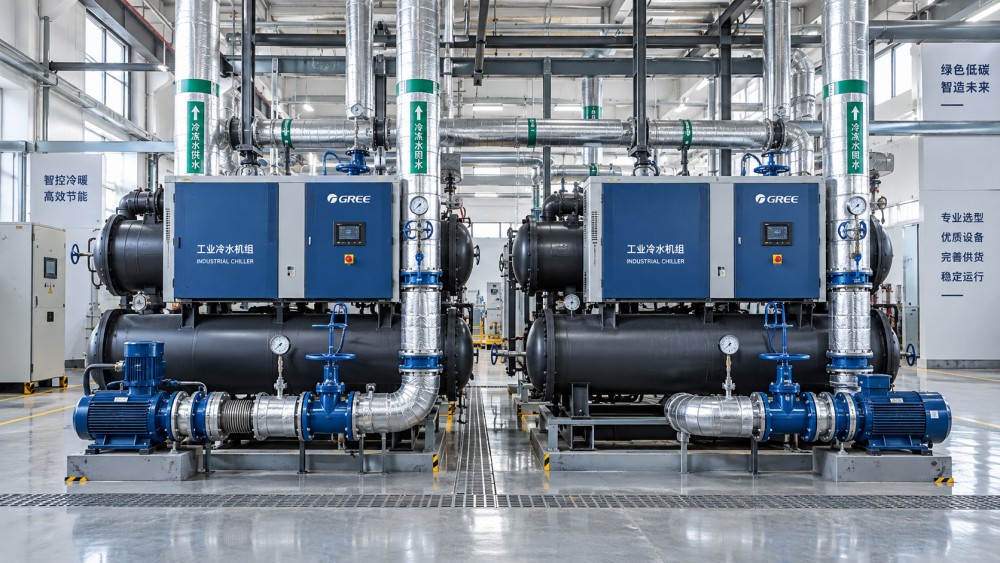
Control integration deserves particular attention. A communication protocol listed on a datasheet does not establish that all required operating commands, alarms, and data points are accessible. Confirm who will configure the interface, demonstrate it with the site system, and maintain access after handover.
Where scope remains unresolved, seek a revised offer rather than assigning an optimistic allowance. A firm local installation quotation is more defensible than a broad percentage added to imported equipment cost.
Make efficiency ratings technically comparable
Efficiency figures are useful only when the test method, rating conditions, and measurement boundary are aligned. A full-load coefficient of performance cannot be compared directly with a seasonal or integrated part-load metric. Nor does compressor efficiency establish the energy consumption of a complete cooling plant.
For chillers, AHRI 550/590 or 551/591 and EN 14511 or EN 14825 may be relevant, depending on the equipment and rating being presented. These references are not interchangeable labels. Ask for the applicable edition, operating conditions, calculation method, and whether the stated result is independently certified or simply declared by the manufacturer.
Separate equipment performance from system performance. Include pumps, fans, cooling towers, auxiliary heaters, and other material loads when estimating annual electricity use. Check whether the rating includes the same auxiliaries in each bid. Otherwise, a proposal can appear more efficient because it measures a smaller boundary.
Use a common operating profile for the annual energy calculation. It should represent expected hours at different loads and ambient conditions, not assume continuous operation at the rated point. For a facility with substantial low-load operation, minimum stable capacity, cycling behavior, and equipment sequencing can affect consumption more than a small full-load efficiency difference.
Require supporting performance maps and identify calculation assumptions. If the data do not cover the proposed operating conditions, the resulting energy estimate should not be treated as a guaranteed saving.
Treat destination compliance as a qualification gate
The equipment’s destination, application, and installation arrangement determine its compliance obligations—not simply the country where it was manufactured. A product legally sold in one market may need different electrical protection, pressure-equipment documentation, refrigerant provisions, or conformity assessment elsewhere.
ASHRAE, ISO, and EN references serve different purposes. ASHRAE standards can address matters such as ventilation, energy performance, and refrigeration safety. ISO standards may govern particular test methods or management systems. EN standards can support European technical and conformity requirements. A general claim of compliance with all three does not establish that a particular model is acceptable for the destination project.
An ISO 9001 certificate, for example, concerns a quality management system; it is not proof of HVAC capacity, electrical safety, or local installation approval. Similarly, CE marking should not be treated as universal approval outside the markets where it applies.
Request a project-specific compliance matrix identifying each applicable requirement, the evidence supplied, and responsibility for any remaining approval. Check that declarations, certificates, and reports cover the actual model and configuration offered. Modifications to electrical components, refrigerants, or pressure assemblies can affect the relevance of existing documentation.
Refrigerant selection also needs a destination-specific review. Restrictions, service availability, safety provisions, and handling requirements can affect installation cost and long-term support. A refrigerant choice should not be accepted solely because it is available at the exporting factory.
Unresolved mandatory compliance should remain a qualification issue. It should not disappear inside a weighted score where a low price offsets an inability to obtain approval.
Build a delivered-and-installed cost, with tax treatment explicit
Normalize quotations to a common currency, exchange-rate date, and delivery boundary. Preserve the original currency and payment schedule so that exchange-rate exposure remains visible. A bid with a large advance payment carries different financing and counterparty risks from one paid mainly after delivery and acceptance.
Incoterms® 2020 can clarify delivery obligations, cost allocation, and transfer of risk when incorporated correctly into the contract. They do not, by themselves, define equipment acceptance, payment terms, warranty, or transfer of ownership. “FOB,” “CIF,” or “DAP” without the named port or place leaves a critical part of the comparison incomplete.
The landed-cost calculation should account for export packing, freight, insurance, customs clearance, applicable duties, destination transport, unloading, and special handling. Oversized equipment may introduce route surveys, permits, restricted delivery windows, or crane requirements that are absent from a standard freight allowance.
Customs treatment depends on classification, origin, destination rules, and available preference documentation. The shipping country is not necessarily the country of origin. Preferential duty treatment should be supported by the relevant origin evidence rather than assumed from the supplier’s location.
Separate recoverable taxes from nonrecoverable costs. Recoverable import VAT may create a cash-flow burden without being a permanent project expense, subject to the applicable rules and the importing entity’s position. Combining it with nonrecoverable duties can distort the economic ranking.
The resulting installed-cost figure should include local installation, integration, commissioning, required approvals, initial spares, and any infrastructure upgrades attributable to the offer. Keep uncertainty allowances separate from confirmed costs so their effect can be examined.
Test whether operating savings justify the premium
Lifecycle comparison should use the same evaluation period, discount rate, energy-price assumptions, and operating profile for every compliant bid. Include maintenance, consumables, expected major replacements, software charges, and residual value where material. Document assumptions that are not supported by firm quotations or guarantees.
Consider an illustrative comparison: Bid A costs $400,000 installed and is estimated to consume 900 MWh annually. Bid B costs $450,000 installed and is estimated to consume 800 MWh. At $120 per MWh, the estimated annual electricity saving is $12,000, giving a simple payback of approximately 4.2 years on the $50,000 premium.
That calculation does not establish a winner. It excludes discounting, maintenance differences, demand charges, and uncertainty in annual consumption. Its value is to show what must be true for the higher investment to make sense. If operating hours are substantially lower than assumed, the premium takes longer to recover.
Run sensitivity tests on the variables most capable of changing the ranking: utilization, electricity prices, exchange rates, maintenance costs, and equipment life. A proposal that wins only under an optimistic energy model deserves more scrutiny than one that remains competitive across credible scenarios.
Keep downtime exposure visible, but avoid presenting unsupported failure probabilities as precise financial costs. Where the consequences of interruption are severe, local spares, repair response, and redundancy may be essential requirements rather than speculative monetary adjustments.
Make the award depend on enforceable commitments
Delivery schedules should distinguish factory completion, shipment, site arrival, installation readiness, and operational acceptance. A short manufacturing lead time does not guarantee an earlier startup if approvals, customs documentation, or local commissioning resources are unresolved.
Warranty wording also needs to match cross-border execution. Establish who diagnoses faults, who pays for labor and travel, how replacement parts reach the site, and whether coverage starts at shipment or acceptance. A long nominal warranty offers limited protection if the destination has no practical service route.
Before award, convert the decisive assumptions into contractual obligations: guaranteed duty at specified conditions, agreed scope boundaries, required documents, test methods, acceptance tolerances, delivery milestones, and remedies for nonperformance. Factory testing can verify specified equipment characteristics; it does not replace site verification of installation and integrated operation.
The final ranking should show quoted price, normalized installed cost, lifecycle-cost results, and unresolved execution risks separately. Where a preferred offer depends on a deviation, record why that deviation is acceptable and who owns its consequences. The defensible choice is not necessarily the cheapest quotation—it is the compliant proposal whose price, performance, and delivery commitments remain credible after every material difference has been exposed.
Recommended News
 VRF ControlVRF Control Systems for Campuses: Managing Multiple Buildings and ZonesVRF control systems for campuses simplify multi-building HVAC management. Explore integration, zoning, costs, and commissioning for a scalable system.Dr. Julian VoltNov 08, 2026
 Maglev ChillersChoosing Magnetic Levitation Chillers: Capacity and Part-Load EfficiencyChoosing Magnetic Levitation Chillers? Compare capacity, part-load efficiency and plant energy use to find the right fit for your facility.Dr. Julian VoltNov 07, 2026
 VRF ControlVRF System Quotation: What to Check Before Comparing Supplier BidsCompare every VRF system quotation with confidence. Learn how to assess capacity, installation scope, controls, warranties, and hidden costs before choosing a supplier.Dr. Julian VoltNov 06, 2026
 Maglev ChillersChoosing a Magnetic Levitation Chiller Exporter: Service and Warranty ChecksChoosing a magnetic levitation chiller exporter? Discover essential service, warranty, spare-parts, and commissioning checks to make a confident investment.Dr. Julian VoltNov 05, 2026