Industry News
Curation by industry experts
Hot Articles
Popular Tags
How compressive strength requirements affect below-grade insulation prices
Higher compressive strength usually increases below-grade insulation prices, but paying for a stronger board only makes sense when the installed system needs that capacity. An unnecessarily high specification can increase material costs across an entire project. An insufficient specification can lead to deformation, floor movement, and repairs that require removing the construction above it.
When assessing what factors influence the overall price of a below-grade insulation project, including materials and labor, start with the loads the insulation must actually support. Then compare products at equivalent thermal performance, moisture suitability, and long-term load resistance. The cheapest board per unit area may not produce the lowest installed cost, while the strongest available board may offer no useful benefit.
A compressive strength rating is not an allowable working load
Compressive strength describes how a material responds when squeezed under specified test conditions. For rigid foam insulation, the published value commonly relates to a defined deformation or a failure point. It does not automatically represent a load the board can carry continuously without unacceptable movement.
This distinction matters beneath floors. A short laboratory test and decades beneath a loaded slab are different conditions. Under sustained pressure, insulation can gradually compress through a process called creep. Even where immediate deformation appears small, additional movement over time may affect floor levels, joints, finishes, or equipment alignment.
The useful purchasing comparison is the product’s suitability for the design load and permitted deformation over the intended service period. A higher headline strength value does not, by itself, establish that suitability. Supporting information should explain the test basis, long-term compressive behavior, and conditions under which the stated performance applies.
Two boards with similar strength labels may therefore be unequal alternatives. Their values may come from different test methods or deformation criteria, and their long-term performance may differ. Converting units makes the numbers easier to read, but does not make unlike test results equivalent.
Determine where the load reaches the insulation
Below-grade applications do not all require the same strength. Exterior foundation-wall insulation encounters soil pressure, backfilling forces, and handling damage. Insulation beneath a floor slab supports loads transmitted through the floor assembly. Insulation beneath a load-bearing foundation is a separate structural application requiring a system specifically designed for that duty.
For a slab, the load includes more than its own weight. Storage, partitions, machinery, vehicle traffic, and rack supports may also matter. Some loads are distributed across broad areas; others enter through small contact points. Their effect at insulation level depends on how the slab spreads them.
A rack foot does not necessarily apply its full contact pressure directly to the board beneath it. Slab thickness, reinforcement, joints, and support conditions influence load distribution. Equally, dividing the total building load by the entire floor area can conceal heavily loaded locations. The structural design needs to establish the relevant stresses at the insulation layer.
Construction loads deserve attention too. Before the slab provides protection and load distribution, workers, material stacks, and equipment may bear directly on exposed insulation. A board selected for completed-building conditions can still suffer damage during installation if temporary loading is poorly controlled.
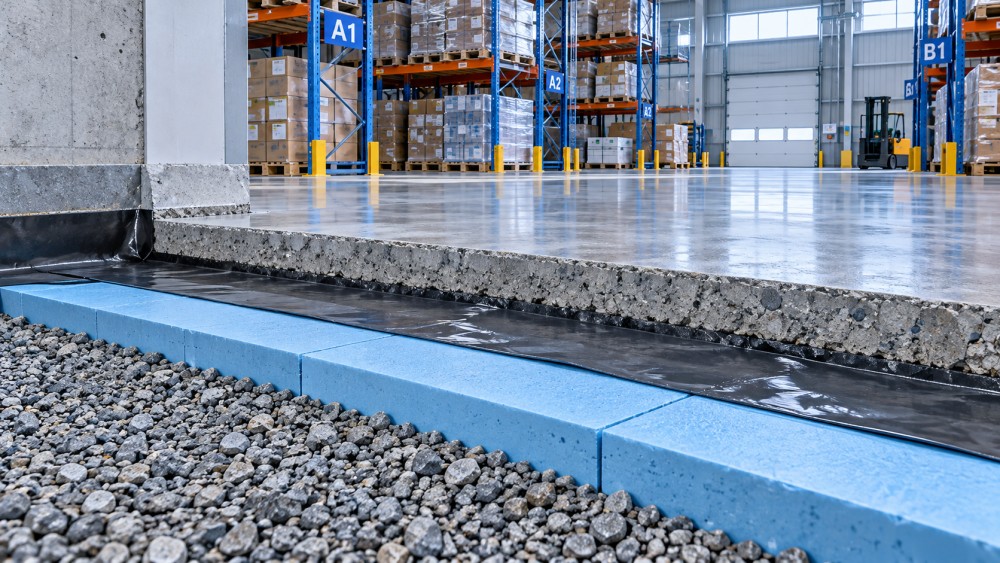
These distinctions can change the purchasing scope substantially. A warehouse might need one approved grade across general floor areas and a different solution around heavily loaded locations. A basement wall might need greater attention to drainage and backfill protection than to the strength required beneath an industrial floor. Applying one premium grade everywhere is convenient, but convenience should be weighed against the actual load map.
Why stronger grades cost more—and when the premium is justified
Within a particular foam product family, greater compressive strength often requires changes in density, formulation, or manufacturing control. Those changes can increase production cost. Higher-strength grades may also have fewer local suppliers or be manufactured less frequently, adding freight costs, minimum-order requirements, and longer lead times.
The relationship is not a universal price ladder. A commonly stocked stronger grade may cost less to deliver than a lower-strength specialist product. Board dimensions, thickness, order volume, and regional availability can outweigh the nominal strength difference. Compare delivered quotations for the required assembly rather than assuming every increase in strength carries a predictable premium.
A premium is justified where the lower-priced alternative cannot meet the required long-term load performance. This is especially relevant where small movements would disrupt machinery, damage sensitive finishes, or affect heavily loaded storage systems. The consequence of deformation matters alongside the load itself.
Paying more for strength is less useful when another property limits suitability. A strong board without appropriate moisture performance is still a poor choice for its exposure. Similarly, greater compressive capacity does not compensate for inadequate thermal resistance, an uneven supporting surface, or missing drainage provisions.
Compare the complete insulation assembly
Extruded polystyrene, expanded polystyrene, and cellular glass can all enter below-grade specifications, but their suitability depends on the particular product and assembly. Material names alone do not establish allowable loads, water resistance, thermal performance, or installation requirements.
EPS is available in different grades, including products intended for demanding compressive applications. XPS is also supplied in multiple strength grades and is commonly specified below grade. Cellular glass offers a different combination of properties, including a rigid, brittle response that makes bedding and detailing particularly important. Each option needs to be assessed using its own documented performance.
Comparisons should hold the required thermal resistance constant. If one material needs greater thickness to deliver the specified insulation value, its apparently lower unit price may be offset by additional material volume, deeper excavation, or changes to floor and foundation details. A stronger grade is not automatically a better thermal insulator.
Below-grade moisture conditions add another requirement. Intermittently damp soil, persistent groundwater exposure, and a drained wall assembly present different conditions. Water absorption data, thermal performance under the intended exposure, and compatibility with waterproofing help determine whether an alternative is suitable.
Drainage and waterproofing remain separate functions. Greater insulation strength does not remove the need to manage water. Where a board includes drainage features or a protective facing, compare the complete system cost: a more expensive board may replace another component, while a cheaper plain board may require additional materials and installation work.
How strength requirements affect materials and labor
The direct price difference between grades is only one part of the budget. The following items explain why two apparently similar insulation quotations can produce different installed totals.
Changing strength grade alone may have little effect on installation labor when board size, thickness, and fixing method remain the same. There is no automatic reason to apply a large labor premium simply because a board has a higher rating. Labor changes when the specification alters handling, cutting, bedding, sequencing, or inspection.
Multiple layers, for example, require additional placement and joint coordination. Different materials may need different tools or bedding methods. A specification using several strength grades creates sorting and identification work, particularly if boards look similar. Those costs should be visible in the quotation.
Ground preparation can be more consequential than the board premium. An uneven base creates gaps and concentrated bearing points. A stronger product does not restore the continuous support assumed by the design. Paying for suitable preparation protects the intended performance of whichever approved grade is selected.
Access also affects labor independently of strength. Restricted excavations, hand-carrying routes, wet conditions, and limited storage can slow installation. Compare quotations on the same site conditions so that an apparently expensive insulation option is not carrying work omitted from a competing offer.
Use different grades only where the savings survive installation
Specifying higher strength only in heavily loaded zones can reduce material spending. This works best when the zones are clearly defined, quantities are substantial enough to justify separate orders, and the installation team can reliably identify each product.
The saving becomes less convincing when high-load areas are scattered, deliveries arrive in small batches, or grade changes require complex cutting. Additional freight, unused packs, supervision, and installation errors can consume the material saving. For a small project, a single approved grade may produce a lower total cost despite a higher board price.
Transitions also need design attention. Adjacent products should meet the required thickness and thermal specification, while differences in stiffness and deformation should be considered within the floor design. Drawings need to show where each grade starts and ends; a purchasing note alone is insufficient.
Future use can affect the decision. A floor intended for light storage may later receive heavier racks or equipment. If that change is reasonably anticipated, including capacity now can be practical because insulation beneath a slab is difficult to replace. The additional capacity should correspond to a defined future load scenario rather than an arbitrary increase in grade.
Make quotations comparable before negotiating price
A useful request for quotation gives suppliers the same performance requirements and installation scope. It should identify the application, required thermal resistance, design loading basis, moisture exposure, thickness constraints, and any permitted alternatives. Otherwise, each supplier may price a different interpretation of the project.
For a clear comparison, request:
- The exact product and grade, with the compressive test basis and relevant long-term load information.
- Board thickness, dimensions, edge configuration, quantity, and any assumptions about waste.
- Delivered material cost, freight, unloading arrangements, minimum order quantities, and lead time.
- Included preparation, placement, protection, membranes, drainage components, and disposal.
- Separate pricing for approved alternatives, with differences in the assembly clearly stated.
Evaluate alternatives in sequence. Establish that the product meets the structural and exposure requirements, then compare installed cost. A lower quote obtained by reducing thickness, omitting protection, or substituting a different load-performance basis does not represent the same purchase.
Before placing the order, resolve the required strength by location and make sure the drawings, product schedule, and quotations agree. That creates a practical basis for controlling cost: paying for capacity where it serves the design, accounting for the work needed to install it correctly, and preventing an apparently economical substitution from changing the performance of a buried assembly.
Recommended News
 VRF ControlVRF Control Systems for Campuses: Managing Multiple Buildings and ZonesVRF control systems for campuses simplify multi-building HVAC management. Explore integration, zoning, costs, and commissioning for a scalable system.Dr. Julian VoltNov 08, 2026
 Maglev ChillersChoosing Magnetic Levitation Chillers: Capacity and Part-Load EfficiencyChoosing Magnetic Levitation Chillers? Compare capacity, part-load efficiency and plant energy use to find the right fit for your facility.Dr. Julian VoltNov 07, 2026
 VRF ControlVRF System Quotation: What to Check Before Comparing Supplier BidsCompare every VRF system quotation with confidence. Learn how to assess capacity, installation scope, controls, warranties, and hidden costs before choosing a supplier.Dr. Julian VoltNov 06, 2026
 Maglev ChillersChoosing a Magnetic Levitation Chiller Exporter: Service and Warranty ChecksChoosing a magnetic levitation chiller exporter? Discover essential service, warranty, spare-parts, and commissioning checks to make a confident investment.Dr. Julian VoltNov 05, 2026