Industry News
Curation by industry experts
Hot Articles
Popular Tags
Do Carbon-Fiber Modular Units Pay Off in Fast-Track Builds?
Do Carbon-Fiber Modular Units truly justify their premium in fast-track construction? For information-driven buyers evaluating speed, structural performance, lifecycle cost, and deployment risk, the answer depends on more than headline productivity claims. This article examines where Carbon-Fiber Modular Units deliver measurable value, how they compare with conventional modular systems, and which project conditions determine whether the investment pays off.
Understanding Carbon-Fiber Modular Units in a Fast-Track Context
In broad industry use, Carbon-Fiber Modular Units refer to prefabricated spatial modules or major subassemblies that integrate carbon-fiber-reinforced composite elements into the structural shell, floor cassette, roof system, or transport frame. In fast-track projects, these units are valued not simply because carbon fiber is advanced, but because lower weight, higher stiffness-to-mass ratios, and controlled factory fabrication can reduce handling constraints during accelerated deployment windows that often range from 8 to 24 weeks.
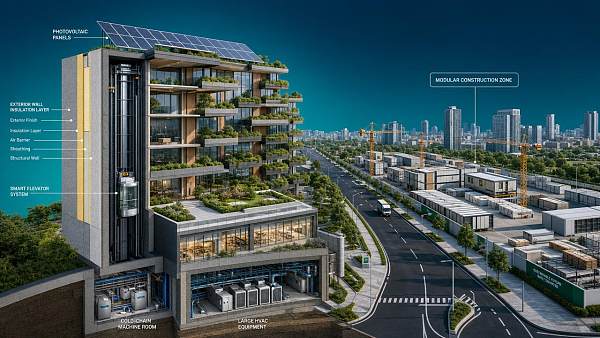
This matters across the wider built-environment and infrastructure sector, especially where G-TSI-style decision frameworks connect spatial systems with thermal performance, resilience, and compliance. A modular unit is not only a structural asset; it may also carry insulation layers, air-sealing interfaces, HVAC penetrations, cold-room envelopes, or specialist internal finishes. When schedules are compressed, every kilogram removed from lifting operations and every hour saved in site assembly can influence crane planning, logistics sequencing, and weather exposure risk.
However, premium materials do not automatically mean better project economics. Carbon-fiber modular construction can be over-specified for routine low-rise buildings with abundant site access and flexible schedules. It becomes more relevant where transport limits, rooftop additions, remote deployment, high corrosion exposure, or repeatable high-performance envelopes create real operational value. For many information researchers, the key question is not whether the material is impressive, but whether the project conditions convert technical advantages into measurable payback within 3 to 10 years.
What usually distinguishes these systems
- Reduced dead load, often supporting easier transport, smaller lifting equipment, or more modules per shipment depending on geometry and local road limits.
- Factory-controlled fabrication that can improve dimensional consistency for service integration, airtightness detailing, and repeatable envelope quality.
- Potential corrosion resistance advantages in marine, humid, or chemical-exposed environments compared with some conventional steel-heavy modular assemblies.
- Higher raw material and fabrication complexity, which can increase upfront cost by a noticeable margin if the design team lacks composite experience.
A practical way to frame the technology is to see it as a strategic option for difficult projects rather than a blanket replacement for steel or volumetric light-gauge modular systems. In some cases, hybrid assemblies are more realistic than full composite structures. Buyers also encounter adjacent market language, product briefs, or generic listings such as 无, which reinforces why technical scope clarification should come before cost comparison.
Why the market is paying attention now
Interest has increased because fast-track construction now intersects with three pressures at once: labor scarcity, tighter delivery deadlines, and a higher need for resilient building envelopes. In sectors such as healthcare support spaces, temperature-sensitive logistics, temporary institutional expansion, and high-value urban retrofits, owners increasingly compare not only capex but also commissioning speed, disruption hours, and lifecycle maintenance frequency.
At the same time, standards-based design expectations have become more stringent. Teams often assess modules against structural, fire, thermal, and indoor-environment performance criteria aligned with common references such as ISO, EN, or ASHRAE-related envelope and HVAC design practices. Carbon-fiber systems do not bypass those requirements; they must fit into them. That means the real discussion is not futuristic branding, but engineering integration and risk allocation.
Why the Industry Cares: Speed, Resilience, and System-Level Efficiency
Fast-track construction is rarely just about finishing earlier. It is usually about reaching occupancy, production, storage, or service continuity sooner. A hospital utility expansion delayed by 6 weeks, a cold-chain staging node that misses seasonal demand, or a commercial retrofit that extends tenant downtime by 20 days can carry opportunity costs far beyond the module price. This is where Carbon-Fiber Modular Units enter the conversation: they may create value by compressing the critical path rather than merely reducing labor hours.
In the broader infrastructure environment, speed must be balanced with durability and system coordination. A light module that arrives quickly but performs poorly in air leakage, thermal bridging, or vibration control may create long-term operating penalties. Conversely, a well-engineered composite-enhanced module can support better envelope continuity, potentially reducing HVAC loads, preserving temperature stability, and simplifying rooftop or constrained-site installation where structural reserves are limited.
Decision-makers also care because speed-related risk is increasingly nonlinear. If a conventional module requires larger cranes, heavier foundation adaptation, or more extensive site road preparation, small logistical delays can multiply. On dense urban sites, saving even 10% to 20% in lift-related complexity can improve sequencing enough to protect target handover dates. That does not mean every project sees those gains, but it explains why composite-backed modular strategies are no longer a niche discussion.
Typical value drivers by project condition
The following overview helps information researchers identify where value tends to appear first. The most important point is that benefits emerge from the interaction of schedule, logistics, structural limits, and operating conditions, not from material choice alone.
The table shows a recurring pattern: the business case strengthens when the module solves a constraint that conventional systems struggle to address. If no meaningful structural, access, corrosion, or downtime challenge exists, the premium may stay visible while the practical advantage remains modest.
System-level relevance beyond structure
For B2B stakeholders managing critical facilities, the module must be assessed as part of a larger operating environment. In temperature-controlled logistics, for example, shell weight is only one layer. What matters equally is insulation continuity, vapor control, service integration, and commissioning discipline. A faster shell installation that causes 2% to 5% extra energy leakage can erase schedule savings over time.
This is why institutional buyers often ask for coordinated reviews covering envelope detailing, HVAC penetrations, floor loading, MEP routing, and maintenance access before deciding whether Carbon-Fiber Modular Units are worthwhile. Lightweight construction helps, but only if it supports the operational target of the facility after handover.
Where the Payoff Becomes Real: Cost, Time, and Lifecycle Tradeoffs
The central investment question is simple: does the premium create enough value in schedule compression, structural efficiency, reduced enabling works, and lower lifecycle burden to justify adoption? In many markets, carbon-fiber-enhanced modular solutions carry a higher upfront package cost than steel-based modular alternatives. Yet direct purchase price alone can be misleading because fast-track projects are driven by total installed cost and time-to-use, not material line items in isolation.
A useful evaluation window is to compare three layers of cost: factory package cost, site and logistics cost, and operational/lifecycle cost over 5 to 15 years. For example, a module that costs more at procurement stage may still pay off if it cuts crane size, reduces temporary works, shortens site occupancy, or avoids structural strengthening. In high-disruption environments, those indirect savings can be more decisive than the module itself.
At the same time, lifecycle performance should be treated carefully. Carbon-fiber systems are not maintenance-free by definition. Interfaces, sealants, coatings, fire protection strategies, and attachment points still need inspection. Payoff is strongest when the design team has addressed joining details, thermal movement, impact resistance, and repairability from the start rather than assuming the material will solve every long-term issue.
A practical comparison framework
The table below does not assign universal rankings, because project variables differ. Instead, it shows how decision criteria often shift when comparing carbon-fiber-enabled modular systems with more conventional modular approaches.
The comparison shows why the answer is project-specific. Carbon-fiber solutions often perform best when installed cost and downtime risk matter more than lowest bid price. Where site access is simple and standard fabrication dominates, conventional modular systems can remain the more rational choice.
Cost signals that often indicate a viable business case
- Structural reinforcement for the host building would otherwise be extensive or time-consuming.
- Access windows are narrow, such as overnight lifts, weekend shutdowns, or weather-limited installation periods.
- Facility downtime has high commercial value, often measured in daily lost throughput or delayed occupancy costs.
- The project program involves repeated units, enabling design amortization and factory process learning over 10, 20, or more modules.
Where several of these conditions exist together, the premium becomes easier to justify. Where none of them apply, the return case weakens quickly.
Typical Applications Across the Broader Built Environment
Carbon-fiber modular strategies are not limited to one industry vertical. Their relevance spans institutional expansion, specialized logistics, infrastructure support buildings, retrofit programs, and temporary-to-semi-permanent facilities. What links these applications is usually a combination of constrained schedules and difficult site conditions rather than architectural novelty alone.
In thermal-system and spatial-infrastructure settings, interest is especially visible where building envelopes must work closely with mechanical systems. Examples include prefabricated service rooms, plant enclosures, conditioned annexes, laboratory support modules, and controlled-environment extensions. In such cases, the structural shell must not compromise thermal bridging control, moisture management, or equipment serviceability.
Another common use case is urban infill or vertical extension, where transport restrictions, limited crane setup space, and occupied-building constraints make lightweight modular construction attractive. Here, the premium may be justified less by pure speed and more by the ability to execute within severe logistical limits while keeping the host facility operational.
Representative application categories
The following categories help frame where Carbon-Fiber Modular Units are most often evaluated in serious project planning.
These categories show that the material conversation is inseparable from operational context. The strongest applications typically combine at least two drivers, such as weight plus speed, or corrosion resistance plus remote deployment.
Where caution is still needed
Even promising applications require disciplined engineering review. Fire performance strategy, acoustic requirements, impact resistance, connection detailing, and future modifications must be examined early. Composite-heavy modules can create downstream complications if the project team assumes conventional field alterations are always acceptable.
It is also important to check the service ecosystem around the chosen approach. If the project location has limited composite repair capability or long lead times for specialized components, resilience planning should account for that reality. The best fast-track solution is not the one with the most advanced brochure, but the one that remains manageable through transport, installation, operation, and maintenance.
Practical Evaluation Steps Before You Decide
For information researchers and pre-procurement teams, the smartest approach is to evaluate Carbon-Fiber Modular Units using a structured screen before moving into detailed design. That screen should test whether the premium is solving a real bottleneck. If the answer is yes, the next step is to quantify that benefit in engineering and schedule terms rather than relying on generalized marketing language.
A practical first pass is to compare baseline and composite-enabled schemes across six dimensions: structural load, transport constraints, site crane plan, schedule compression potential, envelope performance, and lifecycle maintenance implications. If at least 3 of those 6 categories show meaningful improvement, a deeper feasibility review is usually justified. If only one category improves, conventional modular options may remain more economical.
Stakeholders should also request clarity on what portion of the module is actually carbon-fiber-reinforced. Some offerings use full structural composite strategies, while others use selective reinforcement or hybrid framing. This distinction matters because cost, performance, inspection procedures, and code review pathways can differ substantially.
A decision checklist for early-stage assessment
- Confirm whether the project has a hard delivery window, such as a 12-week deployment target or a shutdown period shorter than 30 days.
- Review transport route limits, lifting capacity, and module size-to-weight ratios before comparing package prices.
- Check how the system addresses thermal bridging, airtightness, moisture control, and HVAC/service penetrations.
- Assess maintenance, repair access, and local capability for composite inspection or replacement procedures.
- Verify which standards and test pathways apply to structural, fire, and envelope performance in the target jurisdiction.
Common interpretation mistakes
One common mistake is treating lightweight design as synonymous with lower total cost. In some cases, material savings are outweighed by specialized fabrication and approval complexity. Another mistake is focusing on factory output speed without examining the full handover chain, including foundation readiness, utility connections, inspection sequencing, and commissioning time.
A third mistake is underestimating interface risk. The payoff from Carbon-Fiber Modular Units often depends on how well structure, envelope, and MEP systems are coordinated before production begins. Changes introduced late in the cycle can consume the time savings that made the concept attractive in the first place.
For teams collecting market information, this is also the stage to compare documentation quality. If specifications are unclear, design assumptions are vague, or service integration details are incomplete, the premium should be treated cautiously. In other words, the investment case must be earned by project evidence, not by material prestige.
Why the Right Technical Partner Matters
Fast-track modular decisions sit at the intersection of structure, logistics, thermal performance, compliance, and lifecycle planning. That is why buyers benefit from working with a partner that understands more than isolated product claims. In real projects, the winning solution may be full composite, hybrid modular, or a conventional system optimized around delivery risk. Objective technical interpretation is often more valuable than a one-size-fits-all recommendation.
For organizations evaluating Carbon-Fiber Modular Units, we support decision-making through application analysis, performance benchmarking, and system-fit review across modular construction, thermal infrastructure, and broader building operations. Where useful, we can also help teams interpret generic references such as 无 in the context of actual project requirements rather than surface-level product language.
If you are comparing options for a fast-track build, contact us for targeted support on parameter confirmation, module selection logic, delivery-cycle assessment, thermal-envelope coordination, certification requirements, customization pathways, and quotation-stage technical alignment. A focused early review can often identify whether the premium is justified before costly design assumptions become locked in.
Recommended News
 Modular FabsSustainable Urban Infrastructure Development: Key Systems and Planning RisksSustainable Urban Infrastructure development guide: discover key systems, planning risks, compliance checks, and lifecycle strategies to reduce overruns and improve project resilience.Marcus ShieldJun 03, 2026
 AS/RS Cold StoresGlass Bottles Wholesale for Beverages: Capacity, Closure, and MOQ GuideGlass bottles wholesale for beverages made easier: compare capacity, closures, MOQ, costs, and supplier checks to source safer, scalable packaging with confidence.Dr. Elena FrostJun 03, 2026
 Vertical FlowWholesale Mannequins Buying Guide: Types, Sizes, and Display Use CasesWholesale mannequins buying guide covering types, sizes, materials, and display use cases to help retailers choose durable, brand-ready display solutions.Dr. Victor GearJun 03, 2026
 Rapid Site GearHow to Choose Hardware Parts by Material, Tolerance, and Load RatingHardware parts selection made practical: compare material, tolerance, and load rating to reduce failures, control lifecycle cost, and source components with confidence.Marcus ShieldJun 03, 2026