Industry News
Curation by industry experts
Hot Articles
Popular Tags
Which ASHRAE Standards Apply to Cold Storage Design?
ASHRAE Standards 15 and 34 are the starting point for cold storage refrigeration safety: Standard 15 addresses refrigeration-system safety, while Standard 34 establishes refrigerant designations and safety classifications. They do not, by themselves, provide a complete cold storage design specification. Energy requirements, building ventilation, refrigeration engineering guidance, and product-storage obligations must be assessed separately.
The decisive question is not simply which ASHRAE publications mention refrigeration. It is which requirements apply to the proposed system under the locally adopted codes, and which publications provide useful engineering guidance. A warehouse with a central ammonia plant, a packaged walk-in freezer, and a pharmaceutical cold room can require different compliance paths despite all being described as cold storage.
How the main ASHRAE references differ
ASHRAE publishes both standards and technical guidance. A standard can become enforceable through code adoption or incorporation into project specifications; the ASHRAE Handbook is primarily an engineering reference. Confusing these roles can produce a specification that appears comprehensive but leaves critical responsibilities undefined.
Standards 15 and 34: complementary, not interchangeable
Standard 34 answers a refrigerant-characterization question: what is the refrigerant, and how is it classified? Its classifications distinguish toxicity and flammability characteristics. For example, an A1 classification indicates lower toxicity and no flame propagation under the standard’s specified test conditions; it does not mean that a release is harmless.
A sufficiently large release can displace oxygen, create hazardous concentrations, or expose occupants to other risks. Safety therefore depends on refrigerant quantity, room characteristics, system configuration, and the safeguards required by the applicable rules—not on the classification label alone.
Standard 15 addresses the installation and system-safety side. Depending on the arrangement and applicable edition, the assessment can involve refrigerant quantity limitations, occupancy classification, machinery rooms, detection, ventilation, pressure protection, and discharge arrangements. Standard 34 supplies information used in that assessment; Standard 15 translates the relevant safety framework into system requirements.
This distinction matters when comparing direct and indirect refrigeration. A direct-expansion system introduces refrigerant into evaporators serving the cold room. An indirect system can retain the primary refrigerant in a plant area and circulate a secondary fluid to the storage space. The second arrangement changes potential release locations and exposure pathways, but does not eliminate refrigeration-system safety obligations.
Similarly, placing compressors outdoors does not automatically resolve indoor safety questions. Refrigerant piping and evaporators may still enter occupied or accessible spaces. The design assessment must follow the whole refrigerant circuit rather than just the compressor location.
Ammonia requires a specific code-path check
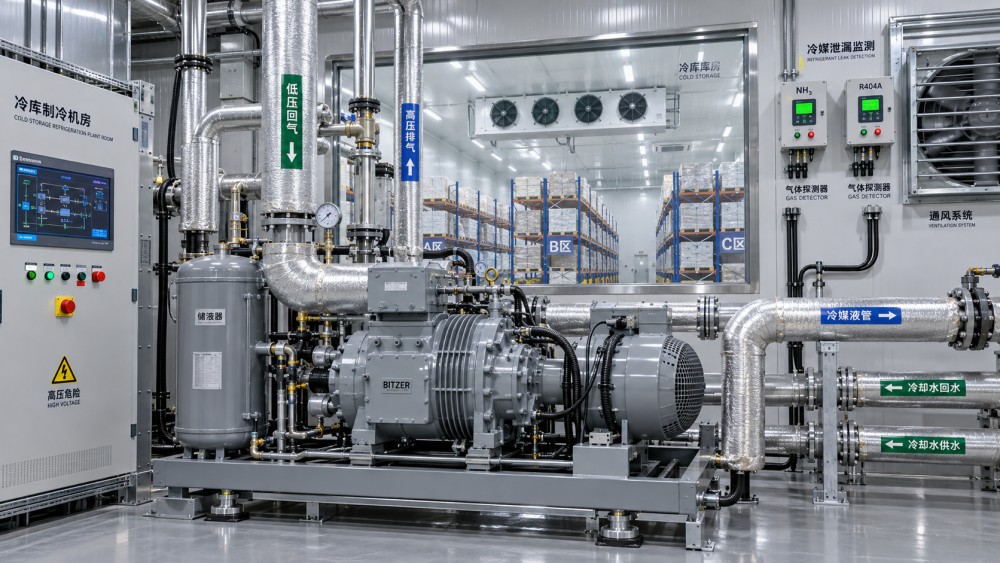
An industrial ammonia installation should not be specified simply as “compliant with ASHRAE 15 and 34.” Ammonia has the designation R-717 and a B2L safety classification under Standard 34, but industrial ammonia design also involves the applicable International Institute of Ammonia Refrigeration (IIAR) standards and their recognition in local mechanical and fire codes.
The scope and exclusions of the adopted Standard 15 edition must be checked alongside those requirements. Where the governing code directs ammonia systems to IIAR standards, those provisions form a central part of the compliance basis. Pressure equipment, piping, worker safety, and environmental obligations may impose additional requirements.
The useful comparison is therefore not “ASHRAE versus IIAR” as competing alternatives. It is how the adopted regulatory framework assigns requirements to each reference. A tender that omits this distinction can leave bidders pricing different machinery-room, detection, ventilation, or documentation assumptions.
Standard 90.1: cold storage is not automatically exempt from energy requirements
A recurring error is to treat the entire refrigerated facility as an exempt industrial process. The opposite error is to apply ordinary comfort-cooling efficiency requirements to every refrigeration component. Neither approach is reliable.
Standard 90.1 includes scope provisions, exceptions, and specific requirements that must be evaluated against the facility. Relevant editions contain provisions addressing refrigeration and refrigerated storage. Offices, lighting, service-water heating, and other covered building systems may also remain subject to energy requirements even where a particular process use receives an exception.
For the refrigeration installation, the applicable text can affect controls and equipment operation, including items such as compressor control, condenser operation, and evaporator-fan control. Exact obligations depend on the adopted edition and the equipment category. Requirements for a refrigerated warehouse should not be inferred from a comfort-air-conditioning equipment table.
The enclosure needs equally careful treatment. A freezer’s insulated panels, doors, penetrations, and floor assembly influence refrigeration load and condensation risk, but the governing energy provisions may distinguish the refrigerated enclosure from other building-envelope elements. A single insulation value copied across the entire facility is not a defensible compliance strategy.
For a project using Standard 90.1, the specification should identify the covered systems, applicable exceptions, and compliance method. It should also distinguish minimum code compliance from the project’s performance targets. Meeting an energy standard does not establish that the refrigeration plant has been optimized for the actual loading schedule, ambient conditions, or door-opening pattern.
The Refrigeration Handbook fills a different design gap
The ASHRAE Handbook—Refrigeration is the principal ASHRAE engineering reference for many cold storage design questions that Standards 15 and 34 do not answer. These include refrigeration loads, commodity-storage considerations, air distribution, insulation, moisture movement, and refrigeration-system arrangements.
A compliant safety design can still fail operationally if the load calculation is incomplete. Transmission through the enclosure is only one load component. Product entering above storage temperature, infiltration through doors, lights, people, handling equipment, evaporator fans, and defrost can all affect the required capacity.
The difference between storage and pull-down is particularly important. A room intended to maintain already-frozen products is not equivalent to a facility expected to freeze incoming goods. The latter must remove product heat over a defined period, potentially including latent heat associated with freezing. Specifying only room volume and temperature leaves this duty unresolved.
Air distribution also creates a distinction between room temperature and product conditions. A sensor near the evaporator does not prove that every pallet position stays within the required range. Racking, packaging, airflow obstruction, and door activity influence temperature distribution. Handbook guidance supports engineering decisions, but the actual installation still needs verification against its operating requirements.
For pharmaceutical storage, ASHRAE references do not replace applicable good distribution or manufacturing practice requirements. Temperature mapping, qualification, calibration, alarm management, and excursion procedures must follow the relevant regulatory and quality framework. Food facilities likewise require commodity-specific storage and food-safety criteria beyond refrigeration-system compliance.
Why Standards 62.1 and 55 should not be applied indiscriminately
A cold storage facility contains spaces with different functions. Offices, welfare rooms, loading areas, refrigerated chambers, and refrigeration machinery rooms should not all receive one ventilation or comfort specification.
Standard 62.1 addresses ventilation and indoor air quality for spaces within its scope. It can be relevant to occupied support areas, but its ventilation provisions do not replace the refrigerant-release safeguards required by refrigeration safety rules. Machinery-room emergency ventilation serves a different purpose from routine ventilation for occupants.
Cold rooms also create a practical trade-off: bringing in outdoor air can add substantial sensible and moisture loads. Moisture entering a freezer can become frost on coils, doors, and surfaces. Necessary ventilation and exposure controls must therefore be coordinated with refrigeration capacity, humidity control, and door management—not omitted to save energy.
Standard 55 is similarly limited in purpose. Its thermal-comfort framework should not be used to establish freezer setpoints or demonstrate safe occupational exposure in low-temperature work. Protective clothing, exposure duration, work practices, and applicable occupational-safety requirements require a separate assessment. Comfort conditions in an adjacent office do not define acceptable conditions inside a frozen-food chamber.
Equipment test standards do not certify the entire facility
Some ASHRAE standards address test methods rather than installation safety or whole-building design. ASHRAE Standard 72, for example, concerns performance testing of commercial refrigerators and freezers. Standard 125 addresses thermal-performance testing of walk-in coolers and freezers. Their scope should be matched to the equipment being purchased.
A test result obtained under a defined method can support comparison, but it must be interpreted with its test conditions and product boundaries. It does not demonstrate the performance of an entire warehouse under different ambient temperatures, product loads, door cycles, or control settings.
This is especially important when comparing quotations. Rated equipment capacity, refrigeration-system capacity at design conditions, and guaranteed room performance are different claims. A meaningful guarantee identifies ambient conditions, entering-product conditions, storage arrangement, allowable temperature variation, and the operating events included in the assessment.
Turn the references into a project-specific compliance basis
The most useful deliverable is a compliance matrix tied to the actual design, rather than a long list of standards. Each cited requirement should have an identified edition, applicable system or space, governing code reference where relevant, and evidence needed to demonstrate compliance.
Before that matrix can be completed, several design facts must be settled:
- Refrigerant and system architecture: refrigerant identity, charge distribution, direct or indirect arrangement, and equipment locations.
- Facility use: occupancy classifications, accessible spaces, storage temperatures, and whether the duty includes cooling or freezing incoming product.
- Regulatory basis: jurisdiction, adopted code editions, local amendments, and the authority having jurisdiction.
- Performance obligations: design ambient conditions, product throughput, temperature tolerances, and required operating resilience.
For internationally sourced equipment, conformity with a supplier’s domestic standard does not establish acceptance at the destination. Equipment approvals, pressure-system requirements, installation rules, and site-level safeguards need to be aligned before procurement. An equipment certificate cannot substitute for approval of the assembled refrigeration installation.
ASHRAE’s official standards publications, published addenda, and the locally adopted codes should be used to establish the final requirements. The latest published edition and the legally adopted edition may differ; a contract can also impose requirements beyond the statutory minimum.
A defensible cold storage specification therefore separates three obligations: refrigeration safety, applicable building and energy compliance, and verified storage performance. Standards 15 and 34 anchor the first where applicable; Standard 90.1 and other adopted provisions address the second; the Refrigeration Handbook supports engineering the third. Keeping those roles distinct is what prevents “ASHRAE compliant” from becoming an ambiguous claim.
Recommended News
 Thermal FlowThermal Management Costs for Industrial Equipment: A Total Cost BreakdownThermal Management cost goes beyond equipment prices. Explore installation, energy, maintenance, and downtime costs to compare industrial cooling bids and make smarter investment decisions.Dr. Julian VoltOct 15, 2026
 Thermal FlowLuxury Home Decor Accessories: How to Assess Materials and CraftsmanshipExplore luxury home decor accessories with confidence. Learn how to assess materials, craftsmanship, and finishes to spot genuine quality and make smarter buying decisions.Dr. Julian VoltOct 14, 2026
 Thermal FlowSourcing From a Decor Factory: Quality Checks, MOQs, and Lead TimesSourcing from a decor factory? Learn how to verify quality, negotiate MOQs, and plan lead times to avoid costly defects and delays. Explore practical tips for smarter buying.Dr. Julian VoltOct 13, 2026
 Modular FabsCan Prefab Construction Meet Local Fire and Building Codes?Can prefabricated construction meet local fire and building codes? Discover key approvals, fire safety details, and supplier checks to help avoid costly delays on your prefab project.Marcus ShieldOct 12, 2026