Industry News
Curation by industry experts
Hot Articles
Popular Tags
What hvac system noise level (db) is acceptable?
Determining what hvac system noise level (db) is acceptable is not just a comfort question—it is a technical performance, compliance, and lifecycle-value issue. For technical evaluators, noise must be assessed against application type, occupancy sensitivity, equipment location, and standards such as ASHRAE and ISO guidance. This article outlines practical dB benchmarks, key measurement considerations, and evaluation factors to help procurement, engineering, and facilities teams judge whether an HVAC system is acoustically suitable for modern commercial, institutional, and industrial environments.
What Does an Acceptable hvac system noise level (db) Mean in Real Projects?
An acceptable hvac system noise level (db) depends on how people use the space, how long exposure lasts, and whether noise affects work, recovery, sleep, or process control.
Technical evaluators should separate sound pressure at the listener from manufacturer sound power data. Both matter, but they answer different procurement questions.
- Sound pressure level reflects what occupants experience at a measured position, usually influenced by distance, room absorption, duct paths, and barriers.
- Sound power level describes source emission and is useful for comparing equipment before installation conditions distort the result.
- A-weighted dB, written as dBA, approximates human hearing response and is commonly used for occupied commercial environments.
For G-TSI benchmarking work, hvac system noise level (db) is treated as a cross-discipline metric, not a minor afterthought. Thermal resilience, indoor environmental quality, and operational reliability must be evaluated together.
Why dB Numbers Can Mislead Without Context
A 45 dBA air terminal in an open office may be acceptable. The same reading in a hospital recovery room can trigger complaints or compliance review.
Noise character also matters. Tonal fan whine, vibration rumble, compressor cycling, or diffuser hiss can feel intrusive even when the average dB value looks reasonable.
Practical hvac system noise level (db) Benchmarks by Space Type
The following reference ranges help technical teams frame early acceptance criteria. They should be refined through local codes, project specifications, and acoustic consultant input.
These figures are not universal limits. They are planning ranges for deciding whether hvac system noise level (db) deserves mitigation, redesign, or contractual acceptance testing.
For sensitive assets, such as pharmaceutical cold-chain facilities or mission-critical command centers, the acoustic criterion should be specified before equipment procurement begins.
Which Factors Change the Acceptable hvac system noise level (db)?
A system that meets a catalog value can still fail after installation. The acceptable hvac system noise level (db) changes with architecture, controls, and operating profile.
- Occupancy sensitivity determines tolerance, especially in hospitals, schools, hotels, laboratories, broadcasting areas, and executive workspaces.
- Equipment placement affects airborne and structure-borne transmission through roofs, slabs, shafts, ducts, and lightweight modular panels.
- Control strategy influences cycling noise, variable-speed tonal shifts, night operation, and simultaneous fan-compressor loading.
- Duct velocity and diffuser selection determine whether airflow becomes a continuous hiss or remains acoustically neutral.
- Maintenance condition affects bearings, belts, fan balance, coil pressure drop, and compressor vibration over the asset lifecycle.
Technical evaluators should therefore request acoustic data at multiple operating points, not only at nominal capacity. Part-load behavior is often where complaints begin.
Why Modular and Prefabricated Buildings Need Extra Attention
In modular construction, lightweight assemblies can transmit vibration differently than conventional concrete structures. A modest hvac system noise level (db) source may become noticeable through resonance.
G-TSI’s spatial-infrastructure perspective links HVAC selection with enclosure design, insulation, penetrations, and mounting details, especially for fast-delivery institutional projects.
How to Compare Equipment Before Procurement
Procurement teams often compare capacity, efficiency, and price first. For long-term value, hvac system noise level (db) should be included in the technical scoring matrix.
The table below shows how common HVAC options differ acoustically. Actual results depend on manufacturer data, installation quality, and acoustic treatment.
A lower catalog dB value does not automatically mean a better solution. Evaluators should compare acoustic output, maintainability, energy profile, and installation risk together.
For high-performance assets, G-TSI recommends treating hvac system noise level (db) as a scored requirement alongside COP, redundancy, filtration, controls, and compliance documentation.
Measurement and Compliance: What Should Technical Evaluators Request?
Noise evaluation should follow a documented method. Otherwise, suppliers may present numbers measured under different distances, loading states, or laboratory conditions.
- Request sound power and sound pressure data, including octave-band information where tonal or low-frequency noise is a concern.
- Confirm whether readings reflect full load, part load, night mode, defrost, compressor staging, or maximum fan speed.
- Define field measurement locations, microphone height, background noise correction, and acceptable operating conditions before commissioning.
- Check whether acoustic expectations reference ASHRAE guidance, ISO measurement principles, EN methods, or local environmental noise rules.
The contract should state how hvac system noise level (db) will be verified. Without a verification clause, disputes often appear after occupancy.
Common Standards and Guidance Categories
ASHRAE guidance is frequently used for HVAC design criteria. ISO and EN frameworks support repeatable measurement, labeling, and environmental assessment practices.
G-TSI does not reduce compliance to a single table value. Instead, it benchmarks equipment behavior against intended use, jurisdictional requirements, and lifecycle risk.
Cost, Mitigation, and Trade-Off Decisions
Improving hvac system noise level (db) usually costs less during design than after installation. Retrofitted acoustic fixes can disrupt operation and reduce available space.
The best approach is not always buying the quietest unit. Sometimes duct redesign, vibration isolation, or better controls deliver stronger lifecycle value.
Cost review should include first cost, energy penalty, installation schedule, maintenance complexity, and complaint risk. Acoustic design is a risk-control investment.
Procurement Checklist for hvac system noise level (db)
When specifications are vague, suppliers may optimize for capacity and price while leaving acoustic performance exposed. A clear checklist reduces ambiguity.
- Define target hvac system noise level (db) for each room category, not only for the overall building.
- Require manufacturer acoustic data with measurement method, distance, loading condition, and octave-band values where applicable.
- Ask bidders to identify all noise sources, including fans, compressors, pumps, cooling towers, dampers, and terminal units.
- Evaluate installation sensitivity, including shafts, roof curbs, structural supports, wall penetrations, and nearby occupied spaces.
- Include commissioning acceptance criteria, corrective action responsibilities, and documentation deliverables in the procurement package.
For technical evaluators, the practical question is not “Is this unit quiet?” It is “Will this system remain acceptable under real operating conditions?”
Red Flags in Supplier Proposals
Be cautious when acoustic data lacks test conditions, when only one operating point is shown, or when installation assumptions are absent.
Another risk is quoting an average hvac system noise level (db) while ignoring low-frequency vibration. Occupants may complain even if the dBA number passes.
FAQ: Technical Questions About hvac system noise level (db)
Is 50 dBA acceptable for a commercial HVAC system?
It depends on the space. In a warehouse office or mechanical support area, 50 dBA may be acceptable. In a meeting room, it is usually too intrusive.
Should technical teams use dBA or octave-band data?
Use dBA for general comparison, but request octave-band data for sensitive spaces. Low-frequency rumble and tonal peaks can be hidden by a single dBA figure.
Can commissioning fix a poor hvac system noise level (db)?
Commissioning can correct fan speed, balancing, vibration, and control issues. It cannot fully overcome undersized ducts, poor equipment location, or missing acoustic separation.
What should be written into the purchase specification?
Specify target room levels, source data requirements, measurement method, acceptance locations, operating modes, and responsibility for corrective work if the criterion is missed.
Why Choose G-TSI for HVAC Acoustic Evaluation and Benchmarking?
G-TSI supports decision-makers who must balance thermal performance, spatial constraints, lifecycle cost, and compliance. hvac system noise level (db) is evaluated within that complete context.
Our benchmarking perspective covers industrial HVAC, cold-chain infrastructure, modular construction, smart vertical transportation environments, and insulation-related acoustic performance.
Technical evaluators can consult G-TSI for parameter confirmation, system selection review, acoustic risk screening, standards alignment, delivery constraints, and supplier data comparison.
If your team is preparing procurement documents, assessing competing proposals, or validating an installed system, G-TSI can help clarify the acceptable hvac system noise level (db) for your exact application.
Recommended News
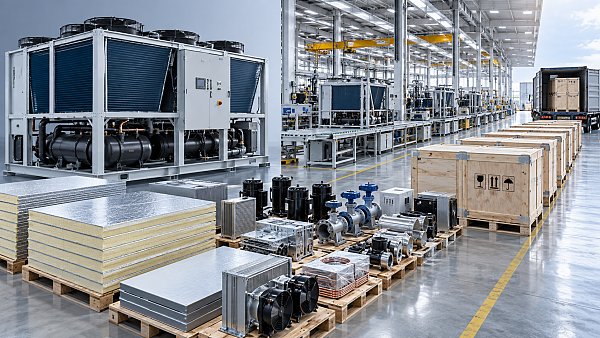
 Thermal FlowHardware Sourcing: How Procurement Teams Evaluate Suppliers, Lead Times, and CostHardware sourcing made smarter: learn how procurement teams assess suppliers, lead times, compliance, and total cost to secure reliable, high-value infrastructure.Dr. Julian VoltSep 23, 2026
 Rapid Site GearHow to Choose Cordless Power Tools for High-Volume Jobsite Work?Cordless power tools for high-volume jobsites: learn how to select reliable battery platforms, optimize runtime, improve safety, and reduce costly downtime.Marcus ShieldSep 22, 2026
 3D Steel ModulesHow to Vet a Prefabricated Construction Systems Supplier for Capacity and Delivery RiskVet a prefabricated construction systems supplier with proven capacity, quality controls, supply-chain resilience, and logistics planning to reduce delivery risk.Marcus ShieldSep 21, 2026
 High-Speed LiftsHow to Specify Gearless High-Speed Elevator Systems for Tall-Building TrafficGearless High-Speed Elevator Systems: learn how to optimize tall-building traffic, ride quality, energy efficiency, resilience, and lifecycle value with a smarter specification strategy.Dr. Victor GearSep 20, 2026